
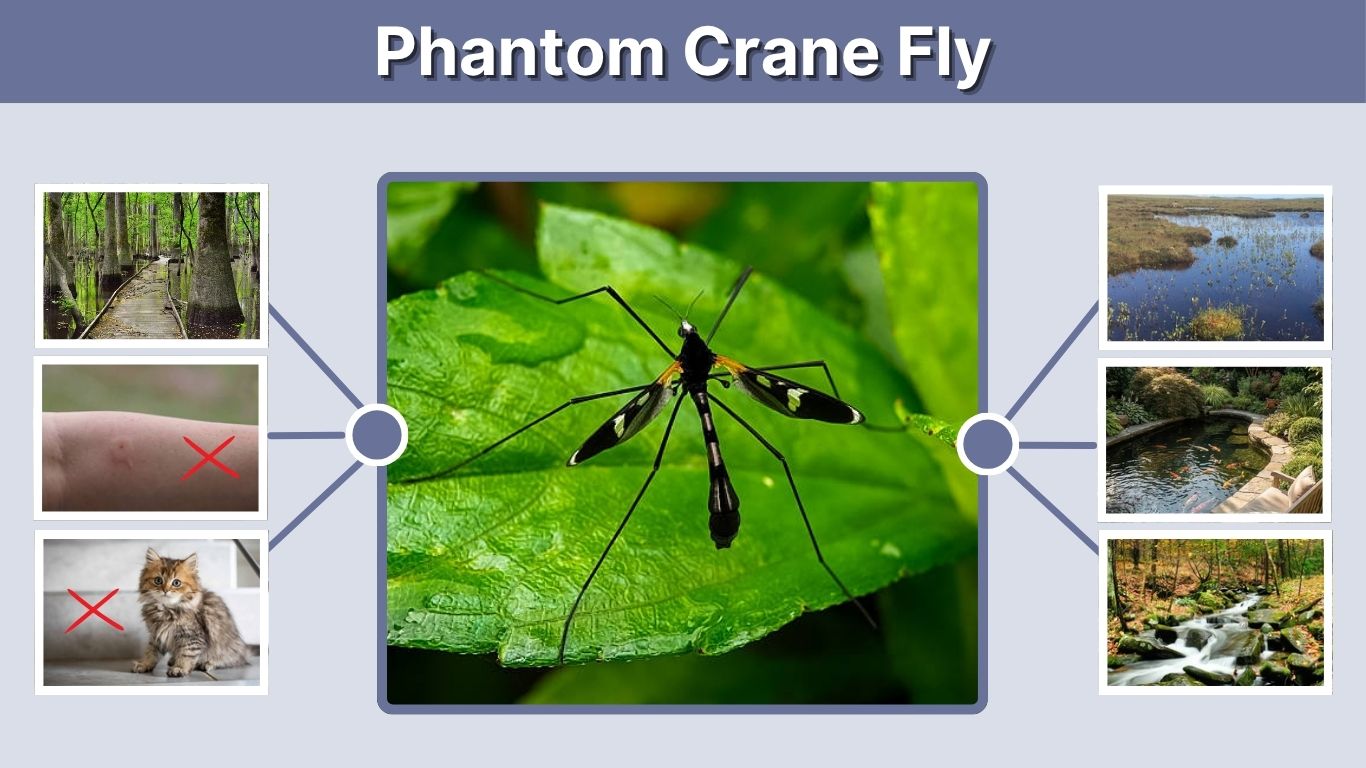
The phantom crane fly is one of North America’s most unusual-looking insects. Its slender body, extremely long legs, bold black-and-white markings, and slow floating movement can make it resemble a drifting spider web or flying snowflake. Despite its alarming appearance, this delicate wetland insect neither bites nor stings people. The best-known species is the eastern phantom crane fly, Bittacomorpha clavipes. Its aquatic larvae live in wet organic material, while adults spend their brief lives floating through shaded vegetation near wetlands.
What Is a Phantom Crane Fly?
A phantom crane fly is a true fly belonging to the family Ptychopteridae, a small group known as phantom and fold-winged crane flies. The insect most commonly called the phantom crane fly in eastern North America is Bittacomorpha clavipes, also known as the eastern phantom crane fly.
Although its name includes “crane fly,” it does not belong to the familiar crane fly family Tipulidae. Both groups have long legs, but phantom crane flies have distinctive body proportions, markings, and flight behavior.
| Feature | Phantom crane fly |
| Scientific name | Bittacomorpha clavipes |
| Insect order | Diptera |
| Family | Ptychopteridae |
| Body length | About ½ inch |
| Color | Mostly black with prominent white markings |
| Habitat | Swamps, marshes, wet woods, and wetland edges |
| Adult season | Mainly spring through early fall |
| Risk to people | Does not bite, sting, or transmit disease |
The name “phantom” likely refers to the way its contrasting markings appear and disappear as the insect drifts through alternating light and shadow. Instead of looking like one clearly outlined insect, it may appear as several disconnected white spots floating through the air.
Phantom Crane Fly Identification
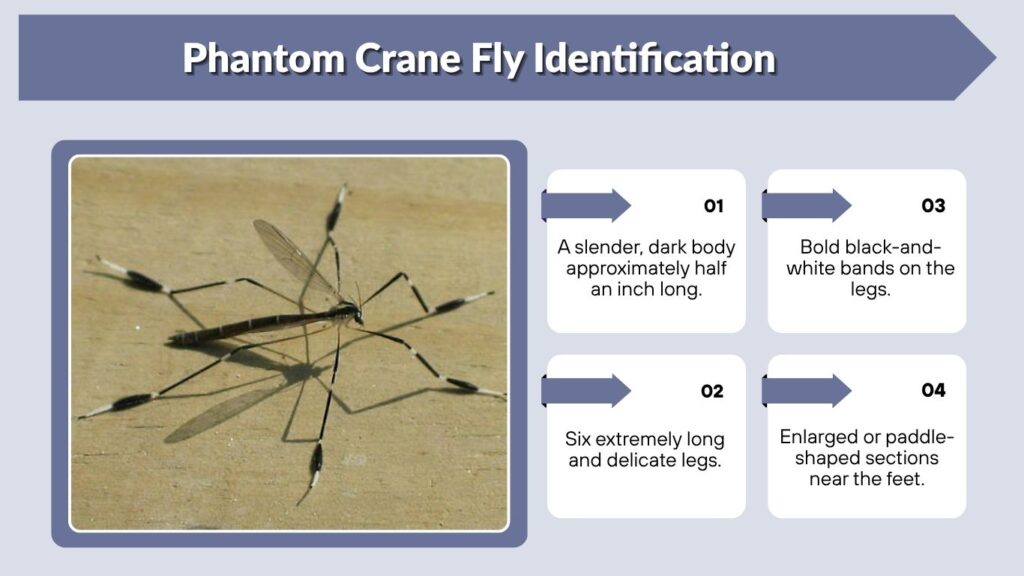
A phantom crane fly is easy to recognize once its most distinctive features are understood. Its body is narrow and relatively small, but its exceptionally long legs make the insect look much larger.
Key Identification Features
Look for the following characteristics:
- A slender, dark body approximately half an inch long
- Six extremely long and delicate legs
- Bold black-and-white bands on the legs
- Enlarged or paddle-shaped sections near the feet
- A pale or white stripe on part of the thorax
- One pair of transparent wings
- Slow, floating flight with the legs spread widely
- A preference for damp, shaded vegetation
The enlarged first segments of the feet, called basitarsi, are particularly important for identifying Bittacomorpha clavipes. This feature separates it from the smaller eastern species Bittacomorphella jonesi. The eastern phantom crane fly can also be separated from the western Bittacomorpha occidentalis by its geographic range and thoracic markings.
Is It a Giant Phantom Crane Fly?
“Giant phantom crane fly” is not generally treated as the formal common name of a separate North American species. People may use the phrase after seeing an eastern phantom crane fly with its legs fully extended.
Its body is not especially large. However, the wide leg span can make it appear much bigger than an ordinary fly. The combined effect of the long legs, enlarged feet, and floating motion creates the illusion of a giant insect.
Why Does the Phantom Crane Fly Float?
The phantom crane fly is best known for its unusual flight. Instead of moving rapidly and directly like a house fly, it floats slowly through vegetation with its legs extended around its body.
The enlarged sections of its feet contain expanded air-filled respiratory tubes. These structures add very little weight while increasing the surface area exposed to the air. As a result, the legs help the insect catch air currents, almost like several small sails or parachutes. The wings still contribute to flight, but the insect can use light breezes to remain suspended while expending relatively little energy.
What Its Flight Looks Like
A flying phantom crane fly may appear to:
- Bounce gently through the air
- Drift sideways or backward
- Hover two or three feet above the ground
- Ricochet softly from leaves
- Move with only limited visible wingbeats
- Disappear momentarily against light and shadow
- Resemble a seed, snowflake, or piece of spider web
It can fly against a light breeze, but stronger air currents greatly influence its direction. Its movement may look random as it travels through grasses, sedges, ferns, and other wetland vegetation.
Where Do Phantom Crane Flies Live?
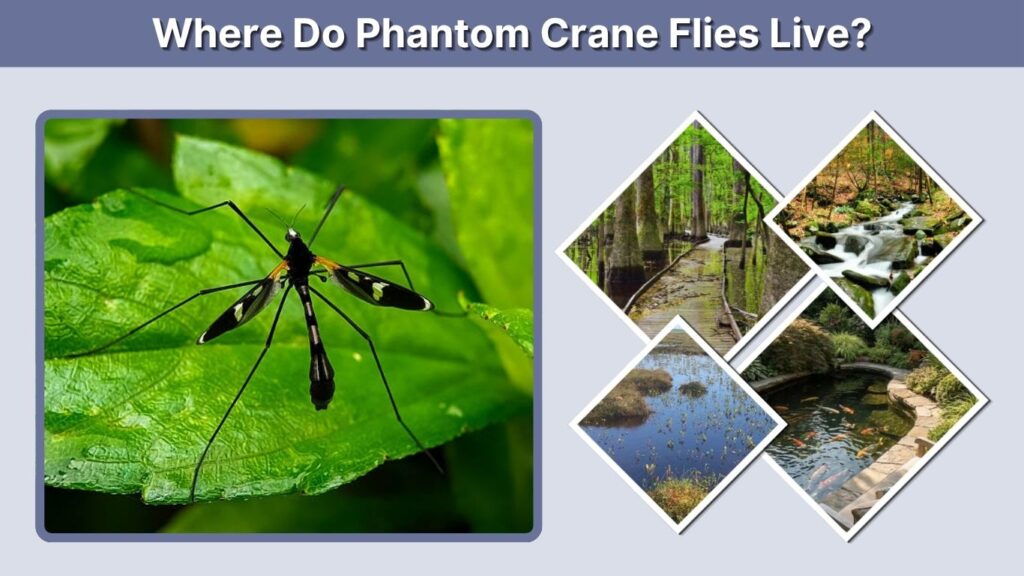
Eastern phantom crane flies are found mainly in North America east of the Rocky Mountains. Their range includes parts of the eastern United States and Canada, with most observations occurring from spring through early fall. BugGuide records are concentrated between April and September.
They are strongly associated with moist habitats because their larvae require wet mud and decaying organic matter.
Common Phantom Crane Fly Habitats
Adults may be seen around:
- Forested swamps
- Marshes and bogs
- Pond margins
- Slow-moving streams
- Alder swamps
- Wet meadows
- Shaded drainage areas
- Dense vegetation beside wetlands
They usually remain close to the damp environments where they developed. Adults often float through low vegetation rather than flying high above open fields. They are not common household pests and do not establish colonies inside buildings.
Seeing one on a wall, porch, or window near a wet area is normally accidental. It may simply be resting or have been carried away from vegetation by the wind.
What Do Phantom Crane Flies Eat?
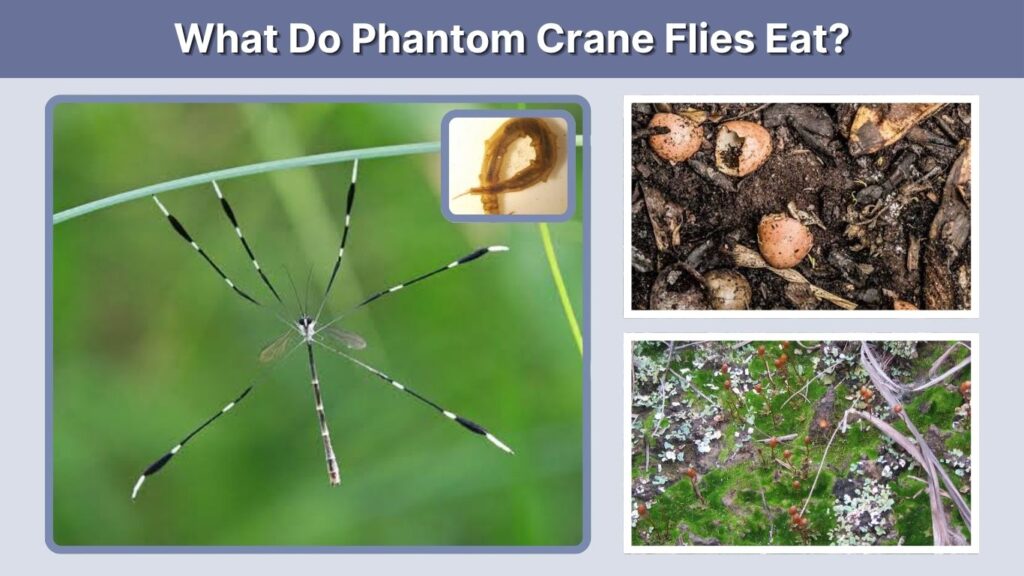
The answer depends on the insect’s life stage. Phantom crane fly larvae feed in wet mud, while adults appear to consume little or no food.
Larval Diet
The larvae are detritivores. They consume decomposing plant material and other fine organic debris in the upper layers of wet sediment. By processing this material, they participate in nutrient recycling within wetland ecosystems.
Adult Diet
Adult phantom crane flies are not blood feeders and do not attack animals. Their adult lives are largely devoted to dispersal and reproduction. Available observations indicate that adults eat very little, and they may not feed at all during their short adult stage.
They therefore do not damage garden plants, stored food, clothing, wood, or household materials.
Phantom Crane Fly Life Cycle
Like other true flies, phantom crane flies undergo complete metamorphosis with four stages: egg, larva, pupa, and adult.
Eggs
After mating, the female flies over shallow water or wet sediment. She dips the tip of her abdomen toward the surface and deposits eggs individually or in small groups. A female may lay hundreds of eggs during this process.
Larvae
The larvae live near the surface of soft wetland mud, where they feed on decomposing organic material. Because this habitat contains relatively little oxygen, each larva has a long retractable breathing tube at the end of its body.
The larva extends this tube through the water’s surface film, allowing it to obtain air while most of its body remains protected in the sediment. During freezing conditions, larvae may burrow more deeply into the mud.
Pupae and Adults
Pupation occurs in the same damp habitat where the larvae developed. The pupa also possesses a long respiratory structure that provides access to atmospheric oxygen.
After emerging, the adult leaves the wet substrate and moves into nearby vegetation. Its primary activities are locating a mate and reproducing. More than one generation may occur in some parts of the species’ range.
Do Phantom Crane Flies Bite?
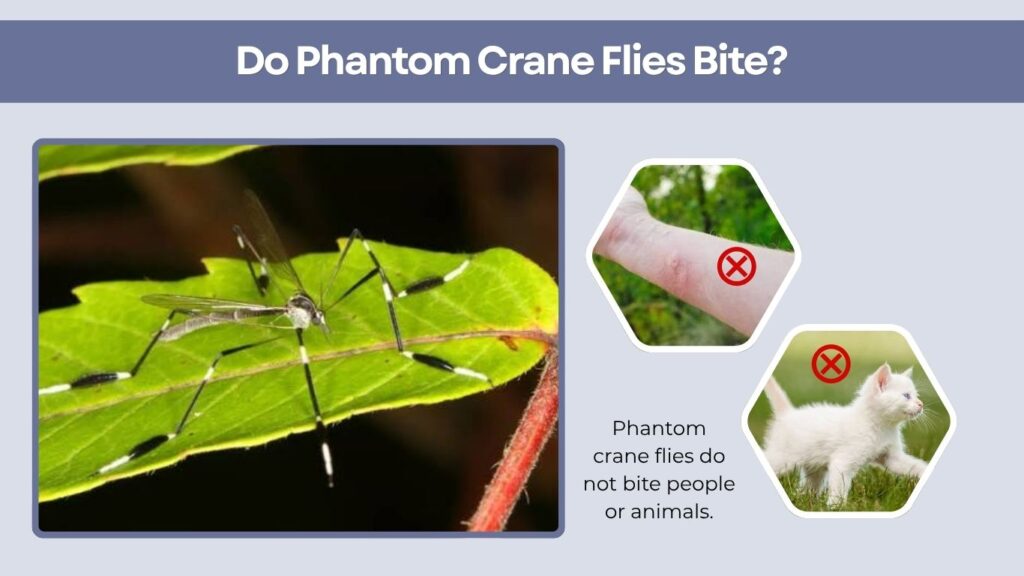
Phantom crane flies do not bite people or animals. They are not blood-feeding insects and lack the behavior associated with mosquitoes, biting midges, horse flies, or deer flies.
They may land on clothing or exposed skin, but this does not indicate an attempt to feed. Their extremely long legs and dark body sometimes cause people to mistake them for large mosquitoes. However, their adult mouthparts are not adapted to pierce human skin, and adults consume little or nothing.
A reported “phantom crane fly bite” is more likely to have come from another insect that was nearby but went unnoticed.
Are Phantom Crane Flies Dangerous?
Phantom crane flies are harmless. They have no stinger, do not inject venom, and are not known to transmit diseases to humans or pets. They also do not possess poisonous body parts that create a hazard through ordinary contact.
Their appearance is their only intimidating quality. The combination of long legs, black-and-white markings, and erratic flight can make the insect seem threatening, especially when it suddenly appears close to someone’s face.
There is normally no reason to kill or control a phantom crane fly. When one enters a building, it can be captured gently with a cup and paper and released near shaded vegetation outdoors.
Phantom Crane Fly vs. Mosquito
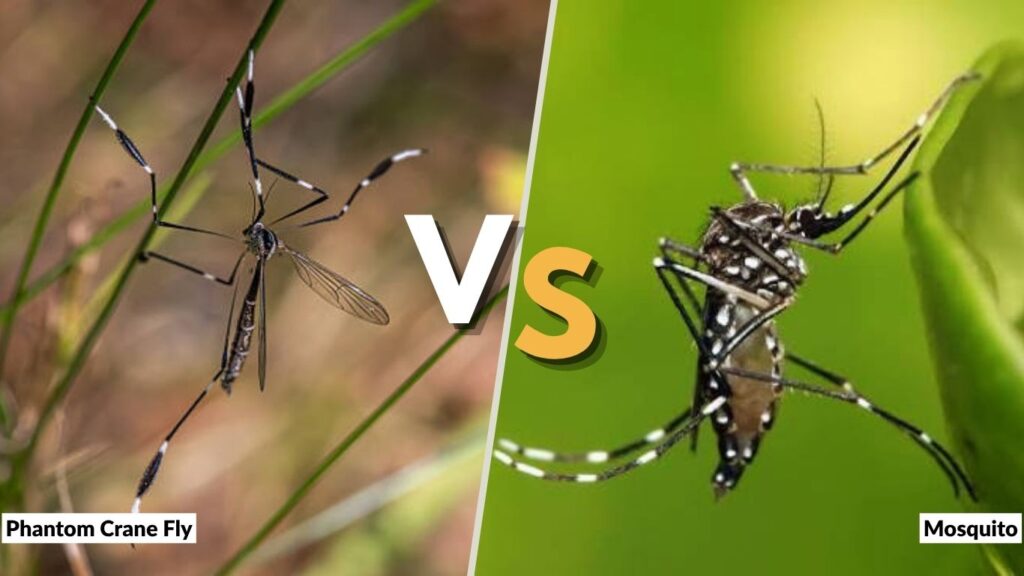
These insects may be confused because both are slender flies associated with wet environments. Their appearance and behavior, however, differ considerably.
| Characteristic | Phantom crane fly | Mosquito |
| Legs | Extremely long with black-and-white bands | Long but usually not strongly banded |
| Feet | Enlarged sections are highly visible | No paddle-like enlarged sections |
| Flight | Slow, floating, and bouncing | More controlled and direct |
| Feeding | Adults eat little or nothing | Females of many species drink blood |
| Human bites | No | Some species bite |
| Disease risk | None known | Some species transmit diseases |
| Typical habitat | Dense vegetation around wetlands | Many habitats near standing water |
The phantom crane fly’s wide, drifting posture is usually the easiest way to distinguish it from a mosquito.
Are Phantom Crane Flies Extinct?
No. The eastern phantom crane fly is an existing species that continues to be recorded across its North American range. Its wetland habitat and unusual movement can make it difficult to notice, so people may assume it is exceptionally rare or extinct.
Local populations may depend on healthy wetlands. Draining, filling, polluting, or heavily altering wet habitats can remove the soft organic sediment required by the larvae.
FAQs
What is the scientific name of the phantom crane fly?
The eastern phantom crane fly’s scientific name is Bittacomorpha clavipes. It belongs to the family Ptychopteridae and the order Diptera. The general name “phantom crane fly” may also be applied to other related members of this family.
How big is a phantom crane fly?
Its slender body is approximately half an inch long, but its extended legs produce a much wider span. Because the body is narrow and the legs are extremely long, a flying individual often appears larger than it really is.
Why is it black and white?
The contrasting bands may help break up the insect’s outline in wetland vegetation where sunlight and shadows create irregular patterns. As it moves, the dark sections become difficult to follow, leaving the pale markings appearing to flicker independently.
What is the spiritual meaning of a phantom crane fly?
Science does not assign spiritual meanings to animal encounters. Some people may personally associate its floating movement with change, lightness, mystery, or adaptability, but these interpretations come from individual beliefs rather than established biology.
Should I remove phantom crane flies from my yard?
Removal is unnecessary. They do not bite, damage plants, invade homes, or create infestations. Their larvae help process decaying organic material in wetlands, and adults are simply temporary visitors in damp, shaded parts of the landscape.