
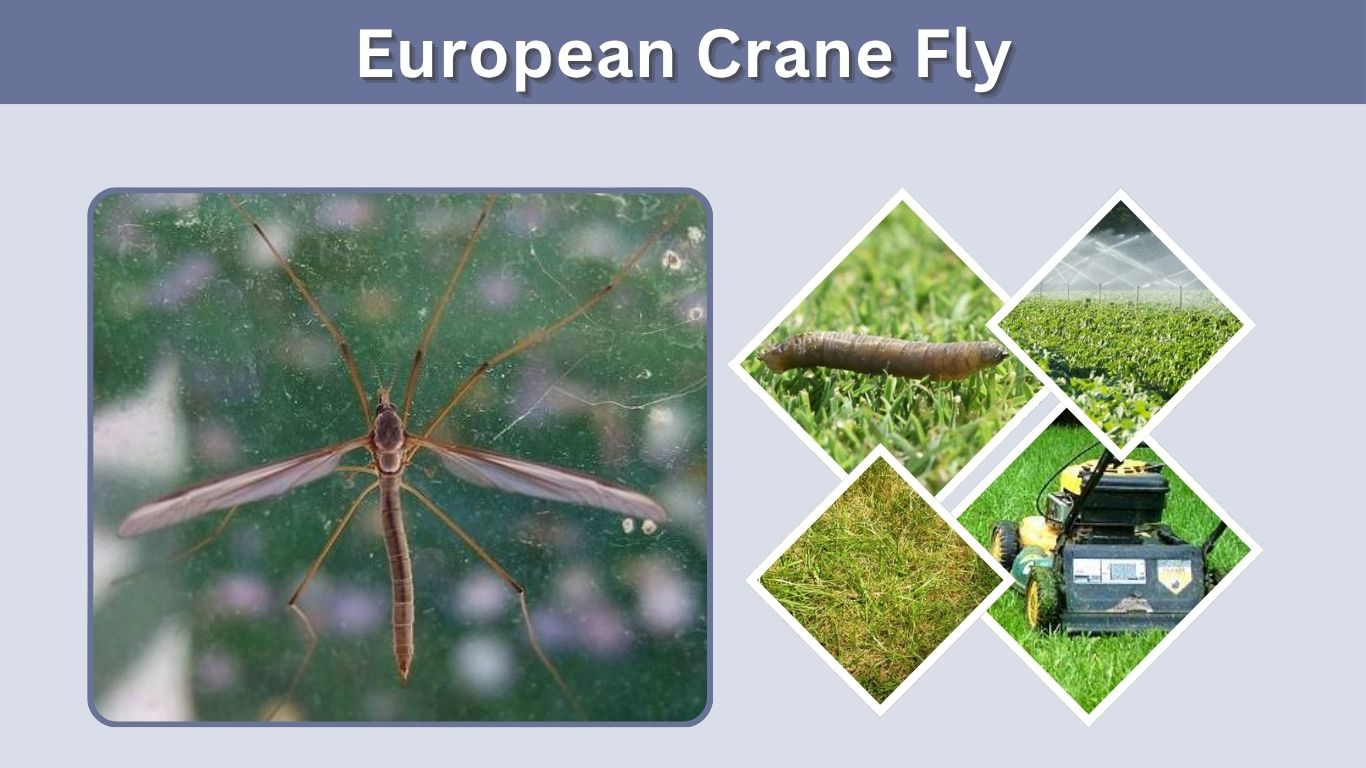
The European crane fly is a long-legged insect frequently mistaken for an oversized mosquito. The adult looks alarming but does not bite, sting, or damage grass. Problems arise from its soil-dwelling larvae, known as leatherjackets, which feed on grass roots, crowns, stems, and blades. Heavy populations can thin or destroy sections of lawns, pastures, and golf-course turf. Understanding its appearance, life cycle, preferred habitat, and seasonal activity makes European crane fly control easier and prevents unnecessary pesticide use.
What Is a European Crane Fly?
The common European crane fly, Tipula paludosa, belongs to the true-fly family Tipulidae. It is native to Europe and northern Africa but has become established in parts of North America. The name “European crane flies” may also include the closely related marsh crane fly, Tipula oleracea, because both are invasive turf pests with similar appearances and feeding habits.
The two species have an important life-cycle difference: T. paludosa generally produces one generation annually, while T. oleracea may produce two. This distinction can affect when adults emerge and when control measures are most effective.
| Feature | European crane fly |
| Scientific name | Tipula paludosa |
| Family | Tipulidae |
| Adult appearance | Long-legged, tan or gray-brown fly |
| Larval name | Leatherjacket |
| Main food | Grass roots, crowns, stems, and blades |
| Primary habitat | Moist lawns, pastures, and grassy areas |
| Risk to people | Does not bite or sting |
| Generations | Usually one per year |
How to Identify a European Crane Fly
Adult European crane flies have delicate tan or gray-brown bodies, extremely long legs, narrow transparent wings, and elongated abdomens. Their bodies are approximately one inch long, although their extended legs make them appear considerably larger. They have one pair of functional wings and a smaller pair of balancing structures called halteres.
People often call these insects “mosquito hawks,” but they are not giant mosquitoes and do not hunt mosquitoes. Adult European crane flies spend their brief lives mating, laying eggs, drinking water, and moving between grassy areas.
European Crane Fly Identification
Look for these characteristics:
- A slender tan, brown, or grayish body
- Six unusually long, fragile legs
- One pair of long, clear wings
- A body roughly one inch long
- Slow, awkward flight close to grass
- Adults resting on lawns, walls, or vegetation
- Large groups appearing after emergence from turf
It can be difficult to distinguish T. paludosa from native crane flies without close examination. Seeing an adult does not prove that the lawn has a damaging infestation because many native crane fly species do not harm turf.
What Do European Crane Fly Larvae Look Like?
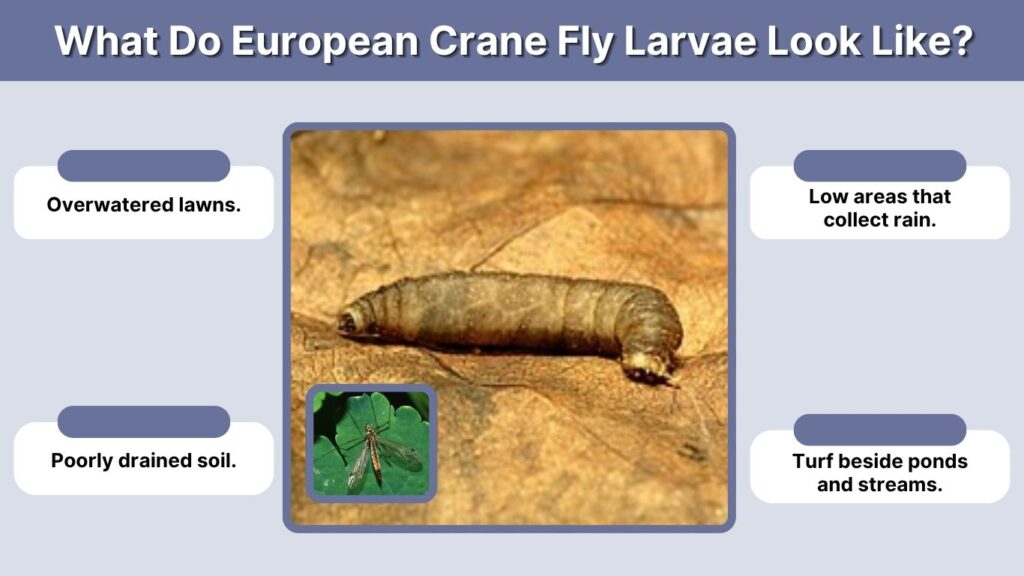
European crane fly larvae are gray, tan, brown, or greenish-gray and have tough, leathery skin, giving them the name “leatherjackets.” They are legless and do not have the obvious hard head capsule seen on many caterpillars. Mature larvae may reach approximately one to one-and-a-half inches long.
The rear end has small, fleshy projections arranged around two breathing openings. When disturbed, the larvae may contract or curl slightly, but they do not form the tight C-shape typical of white grubs.
Where to Find Leatherjackets
Most larvae remain in the upper soil, around the grass roots and the base of the thatch layer. They are especially common in:
- Overwatered lawns
- Poorly drained soil
- Low areas that collect rain
- Turf beside ponds and streams
- Thick thatch
- Shaded, consistently damp grass
- Irrigated golf courses and pastures
European crane fly eggs and young larvae are sensitive to dry conditions. Moist soil therefore increases their chances of surviving and developing.
European Crane Fly Life Cycle
The European crane fly undergoes complete metamorphosis through egg, larval, pupal, and adult stages. Most lawn damage occurs during the long larval period rather than when adults are flying.
Eggs and Young Larvae
Adults emerge mainly during late summer or early fall. After mating, females deposit numerous small black eggs at or near the surface of moist soil. A female may lay up to approximately 300 eggs, often shortly after emerging.
The eggs hatch within about two weeks under favorable conditions. Young larvae begin feeding around grass roots and continue developing through four larval stages.
Overwintering and Spring Feeding
Tipula paludosa usually overwinters as a third-stage larva. Feeding may slow during cold weather but increases as temperatures rise. The largest larvae consume roots, crowns, stems, and grass blades quickly in late winter and spring, when turf growth may not be fast enough to replace the damaged tissue.
Pupae and Adults
Mature larvae stop feeding, move deeper into the soil, and pupate. Before adult emergence, the pupae work their way toward the surface. Empty brown pupal cases may remain protruding from the lawn after the adults have emerged.
| Stage | Typical activity |
| Adult | Emerges, mates, and lays eggs in late summer or fall |
| Egg | Develops near the surface of damp soil |
| Young larva | Feeds beneath turf during fall |
| Overwintering larva | Remains active when conditions permit |
| Mature larva | Causes the heaviest damage in spring |
| Pupa | Develops in soil before adult emergence |
European Crane Fly Lawn Damage
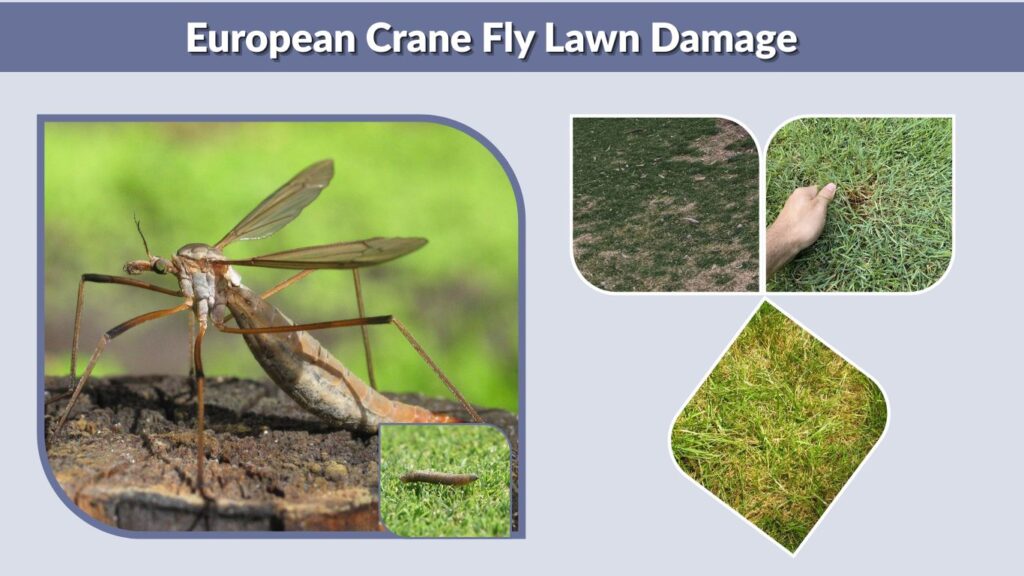
Leatherjackets damage lawns by feeding below and above the soil surface. They chew grass roots and crowns and may emerge during damp nights to consume stems and blades. Damage typically begins as weak or thinning grass and can progress to irregular yellow or bare patches.
Common signs include:
- Thin, weak, or slow-growing turf
- Yellow or brown irregular patches
- Grass that pulls up easily
- Gray-brown leatherjackets beneath the thatch
- Birds pecking repeatedly at the lawn
- Skunks or raccoons digging for larvae
- Empty pupal cases protruding from grass
- Severe damage concentrated in wet areas
Wildlife digging can make an infestation look worse. Birds, skunks, and raccoons are attracted to the larvae and may tear apart already weakened turf while feeding.
How to Check a Lawn for European Crane Fly Larvae
Do not treat a lawn simply because adult crane flies are present. Instead, inspect areas showing poor growth during spring.
Cut and lift several sections of turf measuring approximately six inches by six inches and one to two inches deep. Select samples from the edges of damaged patches, where actively feeding larvae are more likely to remain. Separate the grass, thatch, and upper soil carefully and count the leatherjackets. Multiply the count in each six-inch square by four to estimate the number per square foot.
Treatment thresholds vary according to climate and lawn condition. Research cited by UC IPM indicates that healthy turf may tolerate much larger populations than weak or poorly maintained grass, demonstrating why lawn condition should be considered alongside larval numbers.
How to Control European Crane Flies
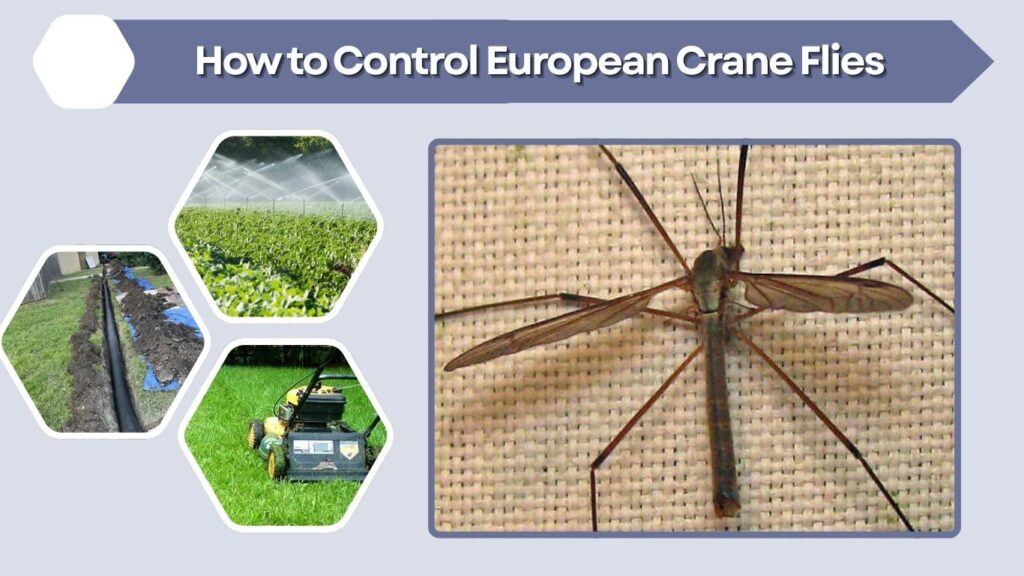
Control should target larvae rather than the harmless, short-lived adults. Begin with lawn management and use insecticides only when monitoring confirms a damaging population.
Improve Drainage and Watering
Reduce unnecessary irrigation, repair drainage problems, and avoid keeping the surface continuously wet. Since eggs and young larvae require moisture, allowing the upper soil to dry appropriately can reduce survival. Do not withhold water to the point that the grass itself becomes severely stressed.
Maintain Healthy Turf
Mow at the recommended height for the grass species, fertilize according to local soil and turf guidance, and reseed bare sections. Vigorous grass with a strong root system can tolerate more feeding than weak turf.
Remove excessive thatch and aerate compacted soil. These practices improve water movement and root development while making conditions less favorable around the soil surface. In persistently shaded locations, replace sun-loving grass with shade-tolerant turf or another suitable groundcover.
Biological Control
Beneficial nematodes may reduce leatherjacket populations when the correct species is selected and applied under appropriate temperature and soil-moisture conditions. UC IPM reports that Steinernema feltiae treatments may provide partial population reduction rather than guaranteed elimination.
Insecticide Treatment
Consider insecticides only after confirming the pest and determining that the population threatens the lawn. Preventive treatment is generally most effective when eggs are hatching and larvae are young near the soil surface. Later curative applications may be less consistent because mature larvae are larger and more difficult to control.
Product registration and recommendations differ by location and change over time. Use only a pesticide labeled for crane fly larvae in turf, follow every label direction, and consult a local extension service or licensed lawn professional for regional timing.
Where Are European Crane Flies Found?
European crane flies are established in parts of Canada and the United States. They have long been important turf pests in the Pacific Northwest, including British Columbia, Washington, Oregon, and coastal northern California. Populations have also been documented in New York and areas of Michigan.
In California, significant damage has occurred primarily in cool, moist coastal locations, while the species causes fewer problems in warmer and drier inland regions. Distribution may continue changing, so suspected discoveries outside established areas should be confirmed by a local extension or insect diagnostic laboratory.
FAQs
Do European crane flies bite?
No. Adult European crane flies do not bite or sting humans or pets. They are not blood feeders and do not have mosquito-like feeding behavior. Their long legs and large size make them look intimidating, but they are physically harmless.
What do European crane flies eat?
Adults generally do not feed, although they may drink water. Their larvae feed on grass roots, crowns, stems, and blades. Therefore, the leatherjacket stage—not the flying adult—is responsible for lawn and pasture damage.
How can I tell crane fly damage from grub damage?
Both can produce thinning grass and attract digging wildlife. Crane fly larvae are gray-brown, legless leatherjackets without the white body, brown head, and C-shaped posture of scarab grubs. Inspecting the soil is necessary for an accurate diagnosis.
Will European crane flies destroy an entire lawn?
Low populations may cause little visible injury, especially in healthy turf. Severe infestations can create extensive bare patches or destroy large areas, particularly in wet, poorly drained lawns where larvae survive well and grass roots are already stressed.
What is the best time to treat European crane fly larvae?
Treatment is generally most effective when larvae are young and close to the soil surface, often during fall after egg hatch. Exact timing depends on the species, regional climate, and product label, so confirm the infestation and obtain local guidance before applying anything.