
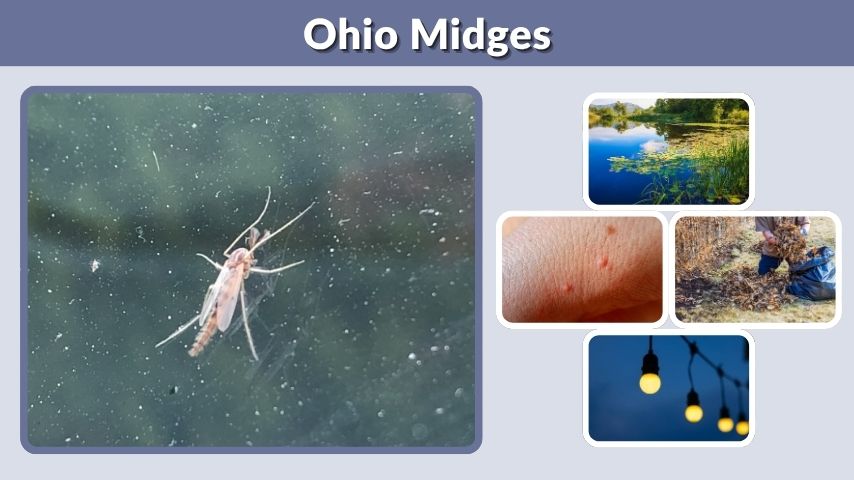
Ohio midges are tiny fly-like insects that often appear in large numbers near lakes, rivers, ponds, and moist areas. Many people notice them swarming around porch lights, windows, vehicles, and waterfront homes during spring and summer. Most Ohio midges do not bite, but some biting species can cause itchy welts. Knowing the difference helps homeowners respond the right way.
What Are Midges in Ohio?
Midges are small insects that look similar to mosquitoes, but they are usually smaller, weaker fliers, and less harmful. In Ohio, the word “midge” can refer to several types of tiny flies. Some are harmless nuisance midges, while others are biting midges that feed on blood.
The most common midges people see in Ohio are non-biting midges. These insects often gather in clouds near water and lights. They may be annoying, but they do not bite people or pets.
Non-Biting Midges
Non-biting midges belong to the family Chironomidae. They are sometimes called lake flies, blind mosquitoes, or muffleheads in certain regions. They look like mosquitoes but do not have the long piercing mouthparts needed to bite.
These midges are especially common near Lake Erie, rivers, wetlands, and stormwater ponds. When they emerge in large numbers, they may cover walls, boats, cars, docks, and outdoor furniture.
Biting Midges
Biting midges belong to the family Ceratopogonidae. They are also called no-see-ums, punkies, or biting gnats. These insects are much smaller than mosquitoes and can be hard to see.
Female biting midges feed on blood and can leave itchy red bumps. They are usually most active around damp areas, wooded edges, wetlands, and still air conditions.
Ohio Midges Quick Facts
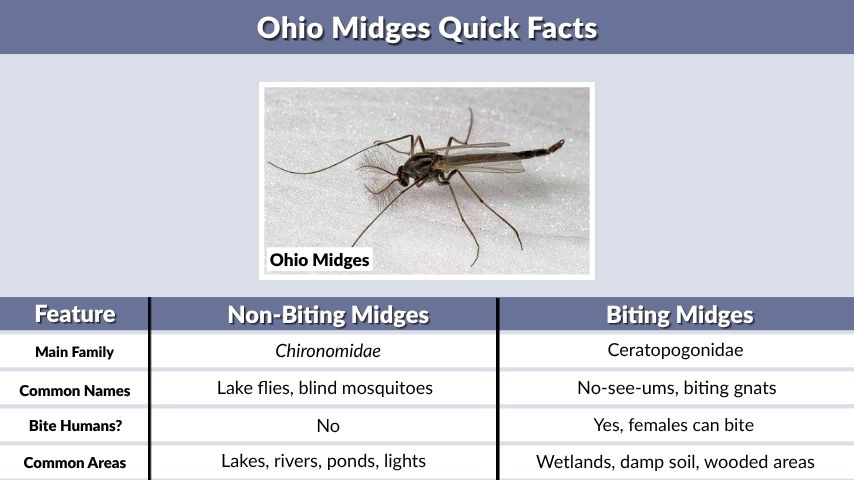
Midges are a normal part of Ohio’s environment, especially around water. The table below explains the key differences homeowners should know.
| Feature | Non-Biting Midges | Biting Midges |
|---|---|---|
| Main Family | Chironomidae | Ceratopogonidae |
| Common Names | Lake flies, blind mosquitoes | No-see-ums, biting gnats |
| Bite Humans? | No | Yes, females can bite |
| Common Areas | Lakes, rivers, ponds, lights | Wetlands, damp soil, wooded areas |
| Main Problem | Swarms and mess | Itchy bites |
| Active Season | Spring through fall | Warm, humid months |
| Attracted to Lights? | Very common | Sometimes |
| Control Focus | Reduce light attraction | Bite prevention and moisture control |
Why Ohio Has So Many Midges
Ohio has many water sources, including Lake Erie, streams, reservoirs, retention ponds, wetlands, and low-lying damp areas. These habitats are ideal for midge development.
Midge larvae live in water, mud, or moist organic material. When conditions are right, adults emerge together in large numbers. This sudden emergence is why a home or neighborhood can seem clear one day and covered with midges the next.
Lake Erie and Waterfront Areas
Northern Ohio, especially areas near Lake Erie, can experience heavy midge activity. Waterfront communities often see swarms in spring and early summer. These swarms may be frustrating, but they are usually made up of non-biting midges.
Lake and river midges are also an important food source for fish, birds, bats, and other wildlife. Although they can be a nuisance, they play a role in the local ecosystem.
Retention Ponds and Neighborhood Water
Midges are not limited to natural lakes. Many Ohio neighborhoods have retention ponds, drainage basins, decorative ponds, and stormwater systems. These areas can produce midges if organic material builds up in the water.
Homes close to these ponds may notice more midges around windows, siding, garages, and porch lights.
What Do Ohio Midges Look Like?
Midges are small, delicate insects with narrow bodies and long legs. Many are gray, brown, black, or pale green. Because they are tiny and mosquito-like, they are often mistaken for mosquitoes.
Non-Biting Midge Appearance
Non-biting midges often have slender bodies and feathery antennae, especially males. They may rest with their front legs raised. They do not have a long biting proboscis like mosquitoes.
They can appear in large groups, especially near lights at night. When crushed, they may leave stains on walls, paint, or outdoor surfaces.
Biting Midge Appearance
Biting midges are much smaller and harder to see. Many are only 1 to 3 millimeters long. Their wings may be clear or patterned, but most people will not notice these details without magnification.
People usually identify biting midges by their bites rather than by seeing the insect.
When Are Midges Most Active in Ohio?
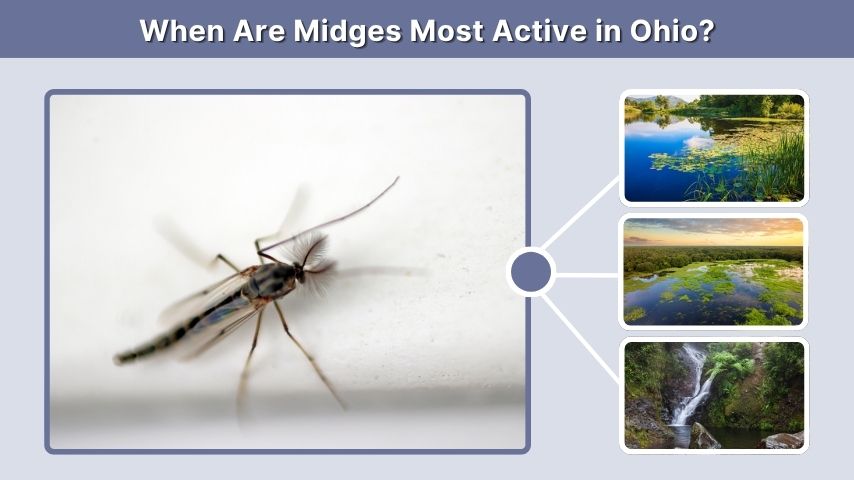
Midge activity in Ohio depends on temperature, moisture, season, and local habitat. They are most noticeable during warm months, but peak timing can vary by region.
Seasonal Activity
Midges commonly appear from spring through fall. Heavy swarms often occur in spring and early summer, especially near large bodies of water. Later in the season, activity may continue around ponds, wetlands, and shaded damp areas.
Warm weather and moisture can trigger larger populations. After rainy periods, some areas may see increased activity.
Daily Activity
Many midges are most active in the evening and at night. Non-biting midges are strongly attracted to lights, which is why they collect around porch lights, windows, streetlights, and illuminated signs.
Biting midges are often worse at dawn, dusk, and during calm humid conditions. Wind usually reduces their activity because they are weak fliers.
Do Ohio Midges Bite?
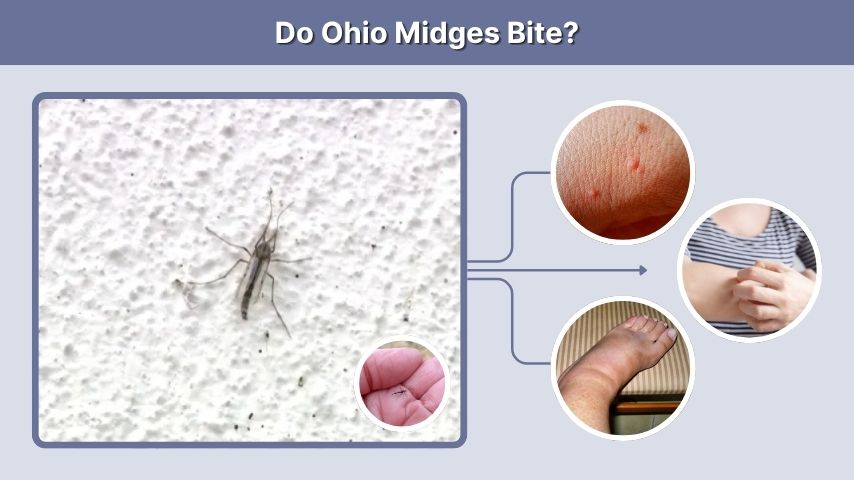
Most midges seen in Ohio swarms do not bite. If you see clouds of mosquito-like insects around lights or lakefront walls, they are often non-biting midges.
However, biting midges do exist in Ohio. These tiny insects can bite people, pets, livestock, and wildlife. Their bites may feel sharp or burning and can become itchy.
Signs of Biting Midge Bites
Biting midge bites may look similar to mosquito bites, but they are often smaller, more clustered, and more irritating for some people.
Common signs include:
- Small red bumps
- Itching that lasts several days
- Mild swelling
- Clusters of bites on exposed skin
- Bites around ankles, arms, neck, or face
- Irritation after outdoor activity near damp areas
Scratching can make bites worse and may lead to skin infection. Wash bites with soap and water and avoid scratching when possible.
Are Midge Bites Dangerous?
For most people in Ohio, biting midge bites are uncomfortable but not dangerous. The biggest concern is itching, swelling, and secondary infection from scratching.
People with sensitive skin may react more strongly. If a bite becomes very swollen, painful, warm, or produces pus, medical advice may be needed.
Why Midges Swarm Around Homes
Midge swarms around homes are usually linked to nearby water and outdoor lights. Adult midges emerge from aquatic or damp habitats, then fly toward bright surfaces and light sources.
Common Attraction Sources
Homeowners often notice midges in the same places every year. These insects are drawn to light and moisture, so small property changes can make a difference.
Common midge attraction points include:
- Porch lights
- Garage lights
- Window lights
- Streetlights
- Pool lights
- White siding
- Light-colored vehicles
- Waterfront decks
- Damp landscaping
- Retention ponds
Turning off unnecessary lights during peak emergence can reduce the number of midges gathering near the home.
How to Prevent Midges Around Your Ohio Home
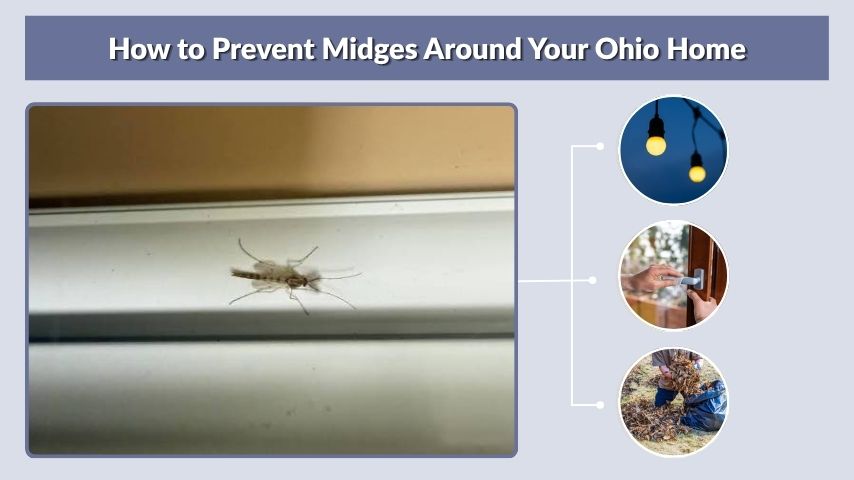
Midges are difficult to eliminate completely, especially if you live near water. The best strategy is to reduce attraction, limit entry, and manage moisture.
Outdoor Prevention Tips
Small changes can make your home less attractive to midge swarms. These steps are especially helpful during spring and summer.
- Turn off porch lights when not needed
- Use yellow or warm outdoor bulbs
- Close curtains at night
- Keep doors and windows sealed
- Repair damaged screens
- Use fans on patios or decks
- Remove wet leaves and organic debris
- Avoid overwatering landscaping
- Keep gutters clean and draining properly
- Move outdoor seating away from bright lights
Fans are helpful because midges are weak fliers. A steady breeze can keep them away from seating areas.
Indoor Prevention Tips
Midges can enter through gaps, torn screens, and open doors. Biting midges are especially tiny, so standard screens may not stop all of them.
To reduce indoor problems, use tight-fitting screens, seal gaps around doors and windows, and keep lights away from open entry points. In severe biting midge areas, finer mesh screens may be useful.
How to Control Midges in Ponds and Yards
If midges are coming from a pond, drainage area, or wet landscape, control should focus on habitat management. Spraying adult insects may give short-term relief, but it usually does not solve the root problem.
Pond and Water Management
Healthy water is less likely to produce severe nuisance insect problems. In residential ponds, excess organic material can support midge larvae.
Helpful pond management steps include:
- Remove decaying leaves from pond edges
- Improve water circulation
- Avoid excess fertilizer runoff
- Reduce algae buildup
- Maintain proper pond depth
- Support natural predators like fish
- Keep shoreline vegetation managed
- Consult a pond professional for severe issues
Some biological control products may target aquatic larvae, but they should be used carefully and according to label directions. Not every product works for every midge species.
Yard Moisture Management
For biting midges, damp soil and organic matter can be important. Reduce wet, shaded areas where possible. Fix drainage problems, clean gutters, thin dense vegetation, and avoid letting mulch stay overly wet.
Good yard maintenance will not remove all midges, but it can reduce local breeding and resting areas.
Should You Spray for Midges?
Spraying can reduce adult midges temporarily, but it is not always the best long-term solution. Since midges often come from nearby lakes, rivers, ponds, or wetlands, new adults may return quickly.
When Spraying May Help
A professional treatment may help before outdoor events, around patios, or in severe nuisance situations. Treatments are usually aimed at resting areas, vegetation, and exterior surfaces.
However, repeated spraying may affect beneficial insects and should be used carefully. For large lakefront swarms, light management and exclusion are often more practical than trying to kill every insect.
When Spraying Will Not Solve the Problem
If the source is a large lake, river, marsh, or public retention pond, one homeowner cannot control the entire population. In these cases, prevention and exclusion are more realistic.
Reducing light attraction, using fans, and sealing the home can make the problem more manageable.
Ohio Midges vs Mosquitoes
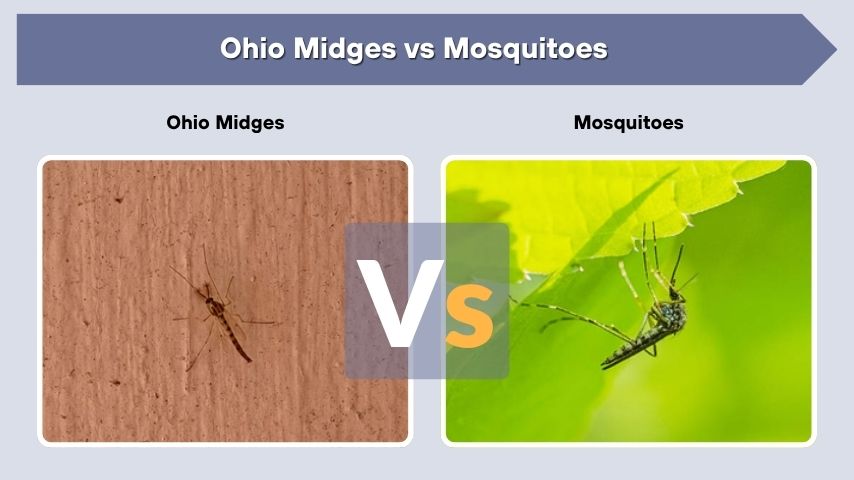
Midges and mosquitoes are often confused because they are both small flying insects found near water. However, they are different pests.
Mosquitoes have a long proboscis and many species bite humans. Non-biting midges do not bite and lack piercing mouthparts. Mosquitoes are usually stronger fliers, while midges often drift in swarms and gather around lights.
If insects are covering walls near lights but not biting, they are likely non-biting midges. If you are getting itchy bites from tiny insects you can barely see, biting midges or mosquitoes may be involved.
Benefits of Midges in Ohio
Although midges are annoying, they are not all bad. Non-biting midges are part of Ohio’s aquatic food web. Their larvae help recycle organic material in water, and adults provide food for fish, birds, bats, spiders, and dragonflies.
Large midge populations can also signal nutrient-rich water. In some cases, heavy swarms may point to excess organic matter in ponds or waterways.
Understanding their role does not make swarms pleasant, but it explains why total elimination is not realistic or environmentally necessary.
FAQs
Are midges common in Ohio?
Yes, midges are common in Ohio, especially near Lake Erie, rivers, ponds, wetlands, and retention basins. They are most noticeable from spring through fall. Many Ohio midges are non-biting and mainly cause nuisance swarms around lights, windows, vehicles, and waterfront areas.
Do Ohio midges bite people?
Some Ohio midges bite, but many do not. Large swarms near lights are often non-biting midges. Biting midges are usually much smaller and may cause itchy red bumps. If bites appear after time outdoors near damp or wooded areas, biting midges may be responsible.
Why are midges covering my house?
Midges often cover houses because they are attracted to light-colored surfaces and outdoor lighting. Homes near water are more likely to see swarms. Porch lights, window lights, garage lights, and bright siding can draw adult midges after they emerge from nearby aquatic habitats.
How do I keep midges away from my porch?
Turn off unnecessary lights, switch to warm yellow bulbs, use outdoor fans, repair screens, and move seating away from bright entry points. Keeping gutters clean and reducing damp organic debris can also help. If midges are coming from nearby water, complete control may not be possible.
Are Ohio midges harmful?
Most Ohio midges are not harmful. Non-biting midges do not bite, sting, or damage structures, though they can create messes when they gather in large numbers. Biting midges can cause itchy bites, but serious health problems are uncommon for most people.