
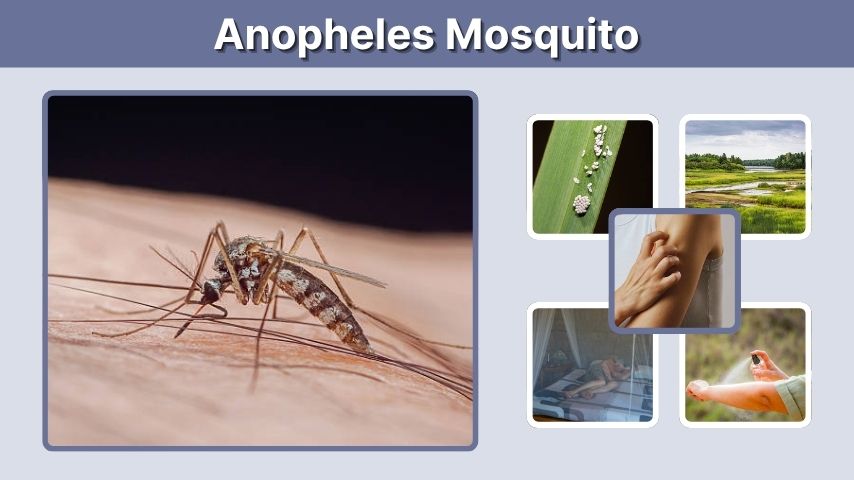
The Anopheles mosquito is best known as the main mosquito group responsible for spreading malaria. While not every Anopheles mosquito carries malaria, certain species can transmit the parasite from one person to another through bites. Understanding how these mosquitoes live, where they breed, and how to identify them can help people reduce mosquito exposure and lower the risk of mosquito-borne disease.
What Is an Anopheles Mosquito?
Anopheles mosquitoes are a genus of mosquitoes found in many parts of the world. They are especially important because some species can carry and transmit malaria parasites. These mosquitoes pass through the same basic life stages as other mosquitoes: egg, larva, pupa, and adult.
The name “Anopheles” is often linked with malaria because several species in this group are effective malaria vectors. A vector is a living organism that can carry and spread a disease-causing agent. In this case, the mosquito can carry Plasmodium parasites, which cause malaria in humans.
Why Anopheles Mosquitoes Matter
Anopheles mosquitoes matter because their behavior makes malaria transmission possible. Female mosquitoes need blood meals to develop eggs. If a female Anopheles mosquito bites a person infected with malaria parasites, the parasite can develop inside the mosquito. Later, when that mosquito bites another person, it may pass the parasite through its saliva.
Key reasons Anopheles mosquitoes are important include:
- Some species transmit malaria.
- They often breed in clean or still water.
- Many species bite during evening, night, or early morning.
- Their larvae and adults can be difficult to control without habitat management.
- Their distribution can change with climate, travel, urban growth, and water storage habits.
How Anopheles Mosquitoes Spread Malaria
Malaria is not spread by casual contact, sharing food, or being near someone who is infected. The most common route is through the bite of an infected female Anopheles mosquito. This makes the mosquito a key part of the malaria life cycle.
The Role of the Female Anopheles Mosquito
Only female mosquitoes bite for blood. Male mosquitoes usually feed on nectar and do not spread malaria. A female Anopheles mosquito becomes a malaria vector only when it feeds on a person who already has malaria parasites in the blood.
After that blood meal, the parasite must develop inside the mosquito. Once the parasite reaches the mosquito’s salivary glands, the mosquito can infect another person during a future bite. This is why one infected mosquito can contribute to disease spread in areas where malaria parasites and suitable mosquito populations are present.
Do All Anopheles Mosquitoes Carry Malaria?
No, not all Anopheles mosquitoes carry malaria. A mosquito must first bite an infected person and allow the parasite to develop inside its body. Also, not every Anopheles species is equally good at spreading malaria.
Some species are major malaria vectors, while others are less important or rarely involved in human malaria transmission. Risk depends on the local mosquito species, climate, human infection levels, housing conditions, prevention measures, and access to diagnosis and treatment.
Anopheles Mosquito Identification
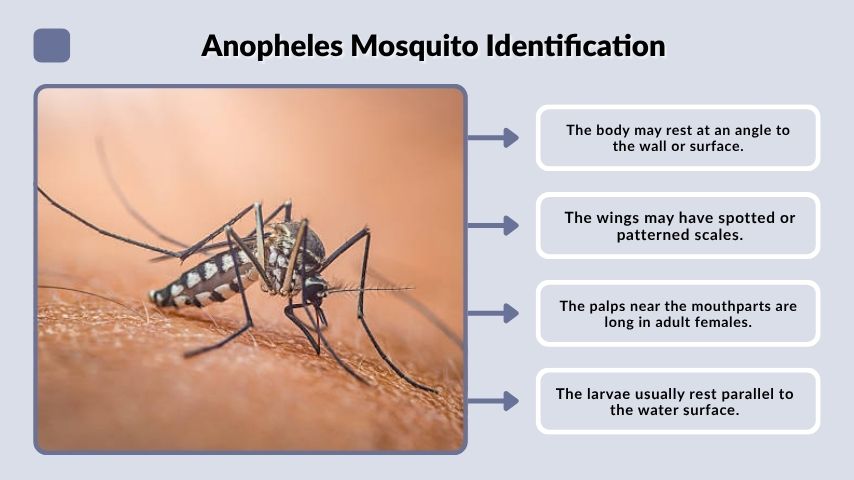
Correct identification can be difficult without magnification or expert help, but Anopheles mosquitoes have several features that separate them from many other mosquitoes. These features are often used by public health workers and mosquito control teams.
Common Identification Features
Adult Anopheles mosquitoes are usually slender and delicate. One of their most noticeable traits is their resting position. Many Anopheles mosquitoes rest with the body angled upward from the surface, rather than keeping the body more parallel like some other mosquito types.
Common identification signs include:
- The body may rest at an angle to the wall or surface.
- The wings may have spotted or patterned scales.
- The palps near the mouthparts are long in adult females.
- The larvae usually rest parallel to the water surface.
- Eggs are often laid singly on water instead of in rafts.
These signs can help with basic recognition, but species-level identification usually requires a trained entomologist or an identification key.
Anopheles vs Aedes vs Culex Mosquitoes
People often compare Anopheles, Aedes, and Culex mosquitoes because they spread different diseases. Anopheles mosquitoes are most strongly associated with malaria, while Aedes mosquitoes are known for dengue, Zika, chikungunya, and yellow fever. Culex mosquitoes may spread diseases such as West Nile virus and Japanese encephalitis in some regions.
| Mosquito Type | Common Disease Link | Typical Breeding Sites | Common Biting Pattern |
| Anopheles | Malaria | Clean, still, or slow-moving water; marshes; edges of streams; water containers in some species | Often evening, night, or early morning |
| Aedes | Dengue, Zika, chikungunya, yellow fever | Small containers, tires, buckets, flower pots | Often daytime, especially morning and late afternoon |
| Culex | West Nile virus, Japanese encephalitis, filariasis in some areas | Polluted water, drains, ponds, stagnant water | Often evening or night |
Life Cycle of an Anopheles Mosquito
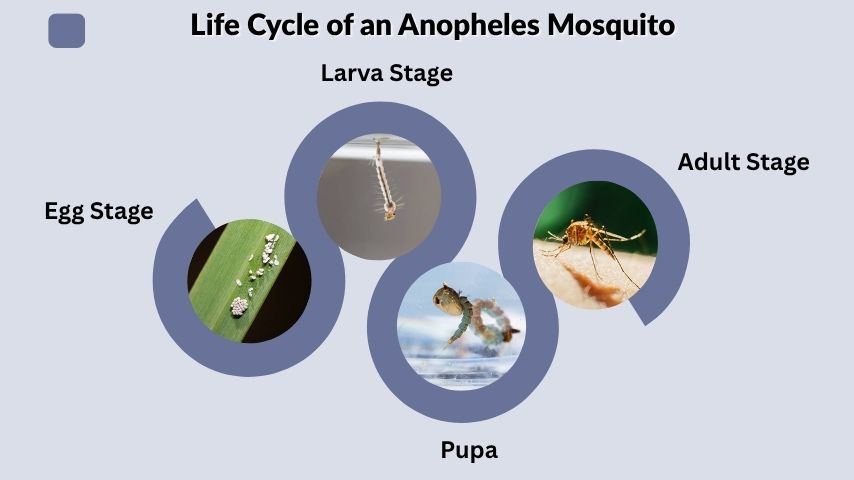
The life cycle of an Anopheles mosquito has four stages: egg, larva, pupa, and adult. The speed of development depends on temperature, water conditions, species, and food availability. In warm conditions, the cycle can happen quickly, which is why mosquito populations can rise fast after rain or flooding.
Egg Stage
Female Anopheles mosquitoes lay eggs directly on water. Unlike some mosquitoes that lay eggs in clusters or rafts, Anopheles eggs are usually laid singly. The eggs float on the water surface and can hatch when conditions are suitable.
Common egg-laying places include shallow water, marshy areas, water edges, rice fields, puddles, ponds, and slow-moving streams. Some species also adapt well to human-made water containers.
Larva Stage
Anopheles mosquito larvae live in water and breathe at the surface. Unlike many Culex larvae, Anopheles larvae usually lie parallel to the water surface. They feed on tiny organic particles and microorganisms.
The larval stage is important for mosquito control because larvae are easier to manage than flying adults. Removing standing water, improving drainage, and using approved larval control methods can reduce the number of adult mosquitoes.
Pupa and Adult Stage
After the larval stage, the mosquito becomes a pupa. Pupae are aquatic but do not feed. This is a short transitional stage before the adult mosquito emerges.
Once adults emerge, males usually feed on plant sugars, while females may seek blood meals for egg production. Adult females are the stage responsible for malaria transmission when they are infected with malaria parasites.
Where Are Anopheles Mosquitoes Found?
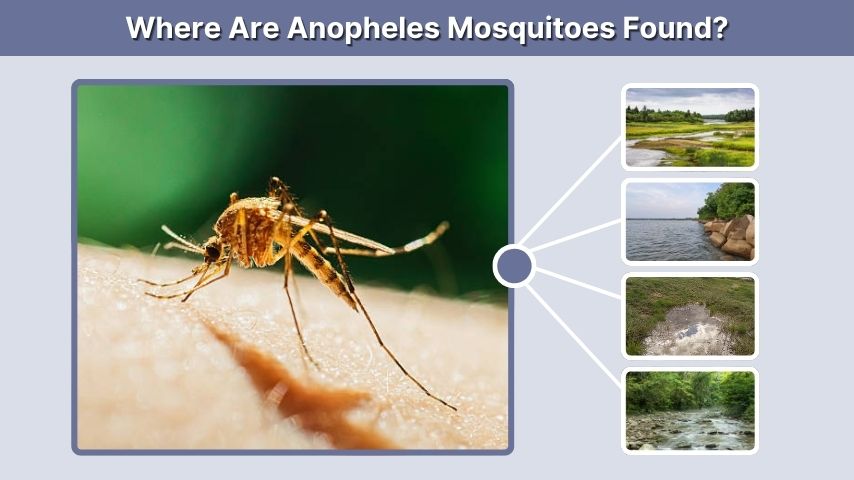
Anopheles mosquitoes are found in many regions, including tropical, subtropical, and some temperate areas. Their presence does not automatically mean malaria transmission is happening. Malaria risk depends on whether the right mosquito species, malaria parasites, human hosts, and environmental conditions are present together.
Common Locations and Habitats
Anopheles mosquitoes are often found near places where their larvae can develop. Many species prefer relatively clean water, though preferences vary by species. Some breed in natural habitats, while others do well in human-made environments.
Common Anopheles mosquito breeding places include:
- Marshes and wetlands
- Edges of rivers, streams, and ponds
- Rice fields and irrigation channels
- Rainwater pools and puddles
- Ditches with standing water
- Water storage tanks and containers
- Construction sites with stagnant water
Controlling breeding sites is one of the most practical ways to reduce local mosquito populations.
Are Anopheles Mosquitoes Found in the United States?
Yes, Anopheles mosquitoes are found in parts of the United States. However, regular malaria transmission is not common in the U.S. today. The presence of Anopheles mosquitoes alone does not mean there is a high malaria risk. Local transmission requires infected people, competent mosquito vectors, and conditions that allow the parasite to develop and spread.
People traveling to malaria-endemic countries should follow medical advice before travel, use mosquito bite prevention, and seek care if symptoms appear after returning.
Important Anopheles Species
There are many Anopheles species, but some are more important for public health because they are efficient malaria vectors. Two commonly searched species are Anopheles gambiae and Anopheles stephensi.
Anopheles gambiae
Anopheles gambiae is one of the most important malaria vectors in Africa. It is not a single simple mosquito in everyday public health discussions; it is often discussed as part of a group of closely related mosquitoes. Some members of this group are highly efficient at spreading malaria.
This species complex is important because it often bites humans and can support malaria parasite development. In areas where Anopheles gambiae is common, malaria control programs often focus on insecticide-treated nets, indoor residual spraying, environmental management, and rapid diagnosis and treatment.
Anopheles stephensi
Anopheles stephensi is another important malaria vector. It is especially concerning because it can adapt to urban environments and breed in water storage containers, tanks, wells, and other human-made water sources.
This mosquito has historically been associated with parts of Asia, but it has also been detected in parts of Africa. Its ability to live in urban settings makes it a public health concern because it can bring malaria risk into densely populated areas if not controlled.
Anopheles Mosquito Bite: What to Know
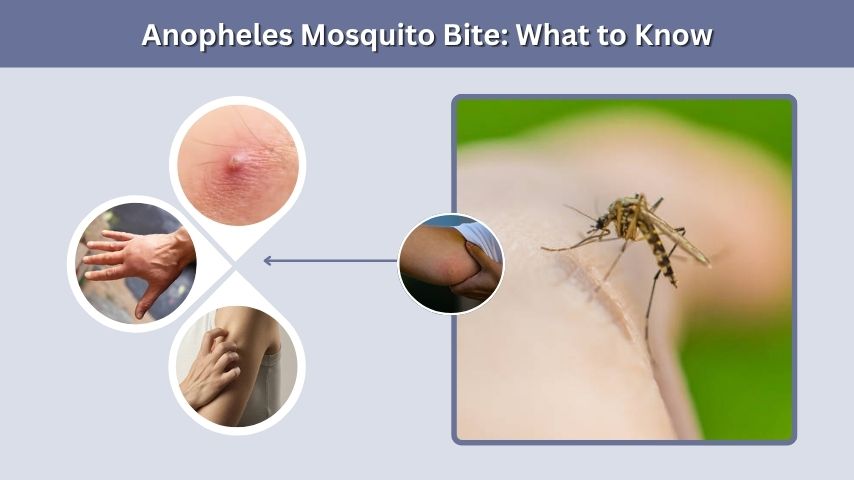
An Anopheles mosquito bite may look similar to other mosquito bites. Most bites cause mild itching, redness, and swelling. You usually cannot tell from the bite mark alone whether the mosquito was Anopheles or whether it carried malaria.
Common Bite Reactions
Most mosquito bites cause minor skin irritation. Some people react more strongly than others, especially children or people sensitive to mosquito saliva.
Common bite reactions include:
- Small red bump
- Itching
- Mild swelling
- Warmth around the bite
- Temporary discomfort
Scratching can break the skin and increase the risk of secondary infection. Washing the area, using a cold compress, and avoiding scratching can help reduce irritation.
When to Seek Medical Help
A mosquito bite itself is usually not an emergency. However, fever after travel to a malaria-risk area should be taken seriously. Malaria symptoms can include fever, chills, headache, sweating, fatigue, nausea, and body aches. Severe malaria can become life-threatening without treatment.
Medical care is especially important for children, pregnant women, older adults, and people with weakened immune systems. Anyone who develops fever after being in a malaria-endemic area should contact a healthcare provider promptly.
How to Prevent Anopheles Mosquitoes
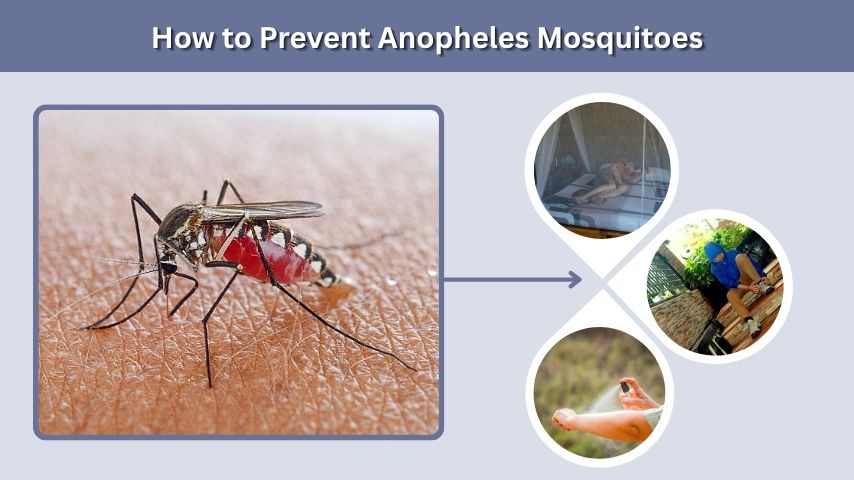
Preventing Anopheles mosquito bites requires a combination of personal protection and environmental control. Since many Anopheles mosquitoes bite during evening and nighttime hours, protection while sleeping is especially important in malaria-risk areas.
Personal Protection Tips
People can reduce bites by using proven mosquito prevention methods. These steps are especially important in areas where malaria is present.
Helpful prevention methods include:
- Sleep under an insecticide-treated bed net in malaria-risk areas.
- Use EPA-registered or locally approved mosquito repellents.
- Wear long sleeves, long pants, and socks when mosquitoes are active.
- Install or repair window and door screens.
- Use air conditioning or fans where available.
- Avoid sleeping outdoors without protection.
- Follow travel medicine advice before visiting malaria-endemic areas.
Travelers may also need antimalarial medicine depending on destination, season, and health status. A healthcare provider or travel clinic can recommend the right option.
Reducing Breeding Sites
Mosquito control also depends on removing or managing standing water. Anopheles mosquitoes need water for their immature stages, so reducing breeding places can lower mosquito numbers.
Useful habitat control steps include:
- Empty unused buckets, tires, pots, and containers.
- Cover water storage tanks tightly.
- Clear blocked drains and gutters.
- Fill low areas where water collects.
- Manage irrigation water carefully.
- Keep construction sites from holding stagnant water.
- Support community mosquito control programs.
In many places, mosquito control works best when households, communities, and public health teams work together.
Common Myths About Anopheles Mosquitoes
Many people misunderstand how Anopheles mosquitoes and malaria transmission work. Clearing up these myths helps people focus on the prevention steps that actually matter.
Myth 1: Every Anopheles Mosquito Has Malaria
Not every Anopheles mosquito is infected. The mosquito must first bite a person with malaria parasites, and the parasite must develop inside the mosquito before it can spread disease.
Myth 2: Male Anopheles Mosquitoes Spread Malaria
Male mosquitoes do not take blood meals and do not transmit malaria. Female mosquitoes bite because they need blood to help produce eggs.
Myth 3: You Can Identify Malaria Risk From the Bite Mark
A bite mark cannot confirm whether a mosquito was infected. Malaria risk depends on location, mosquito species, local transmission, and exposure history.
Myth 4: Anopheles Mosquitoes Only Live in Forests
Some Anopheles species live near wetlands, streams, and rural areas, but others can adapt to urban environments. Water storage containers and construction sites may also support breeding in some regions.
FAQs
What is an Anopheles mosquito?
An Anopheles mosquito is a mosquito from the genus Anopheles. Some species in this group can transmit malaria parasites to humans. They pass through egg, larva, pupa, and adult stages and often breed in still or slow-moving water.
Why does only the female Anopheles mosquito spread malaria?
Only female mosquitoes take blood meals, which they need for egg production. If a female Anopheles mosquito bites a person with malaria parasites, the parasite can develop inside the mosquito and later be passed to another person through a bite.
How can I identify an Anopheles mosquito?
Anopheles mosquitoes often rest with their bodies angled upward from the surface. Their larvae usually lie parallel to the water surface. Some species also have spotted wings. Exact identification usually requires expert examination or an identification key.
Where do Anopheles mosquitoes breed?
Anopheles mosquitoes commonly breed in standing or slow-moving water. Breeding sites may include marshes, ponds, puddles, rice fields, stream edges, ditches, irrigation channels, and water storage containers, depending on the species and local environment.
Do Anopheles mosquitoes transmit dengue?
Anopheles mosquitoes are mainly known for malaria transmission. Dengue is usually spread by Aedes mosquitoes, especially Aedes aegypti and Aedes albopictus. Because mosquito-borne diseases vary by region, local public health guidance is important.