
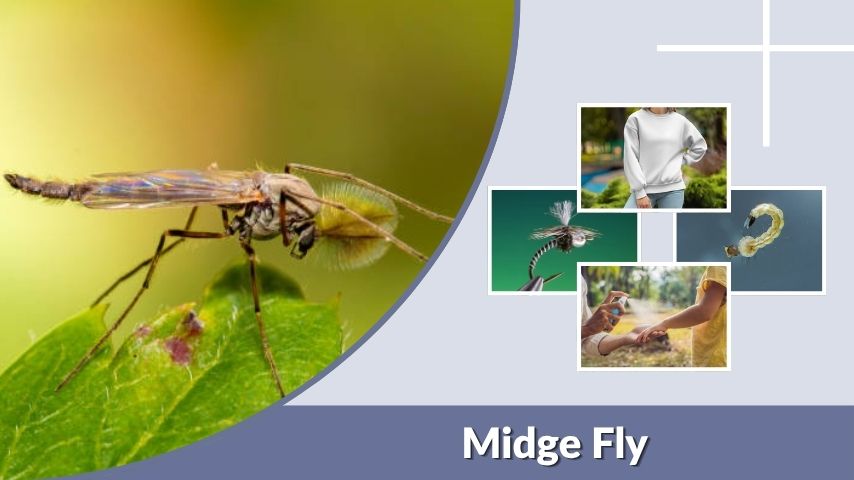
A midge fly is a tiny fly that is often mistaken for a mosquito. These insects may gather in large swarms near water, lights, windows, patios, lakes, ponds, and damp outdoor spaces. Some midges do not bite, while others are biting pests known as no-see-ums. Because the name “midge” is used for several small fly groups, understanding the difference is important for identification, bite prevention, and control.
What Is a Midge Fly?
A midge fly is a small, delicate, two-winged insect. Many people use the term for non-biting midges, especially the mosquito-like flies that swarm near lights but do not feed on blood. Others use it for biting midges, which are tiny flies that can leave itchy bites.
Midges belong to the same broad insect order as mosquitoes and house flies, but they are not all the same type of insect. Some are mostly a nuisance, some are important food for fish and birds, some affect crops, and some bite animals or humans.
Why the Name Causes Confusion
The word “midge” is not always used in one exact way. It may refer to:
- Non-biting midges
- Biting midges or no-see-ums
- Gall midges that affect plants
- Midge larvae used as fish food
- Artificial midge flies used in fly fishing
This is why people searching for “midge fly” may be looking for pest control, bite information, larvae identification, or fly-fishing patterns. The right answer depends on the context.
What Do Midge Flies Look Like?
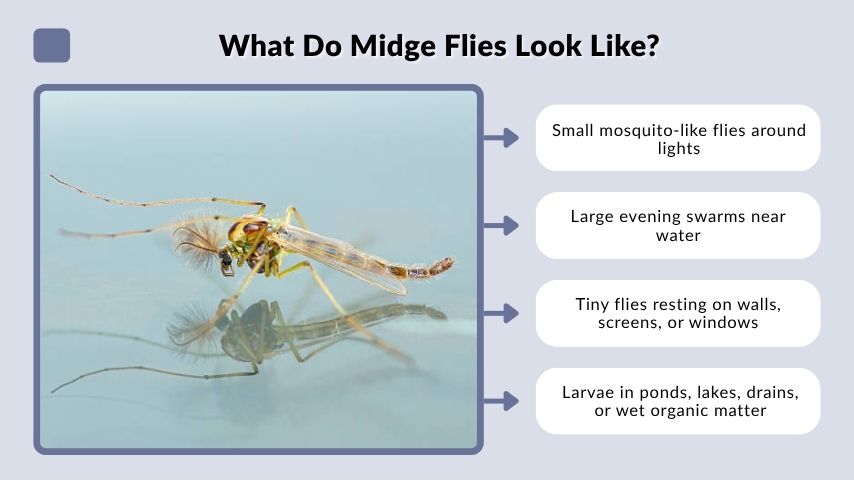
Midge flies are usually small, slender, and mosquito-like. Many have long legs, narrow bodies, and delicate wings. Adult non-biting midges often rest with their front legs raised, which can make them look even more like mosquitoes.
However, midges are generally smaller and more fragile-looking than mosquitoes. Non-biting midges do not have the long piercing mouthpart that female mosquitoes use to suck blood. Biting midges are much smaller and may be difficult to see clearly without magnification.
Common Identification Signs
You may be looking at a midge fly if you notice:
- Small mosquito-like flies around lights
- Large evening swarms near water
- Tiny flies resting on walls, screens, or windows
- Larvae in ponds, lakes, drains, or wet organic matter
- Itchy bites after outdoor exposure in areas with no-see-ums
The location helps with identification. Swarms near lakes or porch lights are often non-biting midges. Painful or itchy bites from insects you barely saw may point toward biting midges.
Midge Fly vs Mosquito
Midge flies and mosquitoes are commonly confused because both are small, delicate flies that may appear near water. Still, they are different in important ways.
Mosquitoes are known for their piercing mouthparts, and females of many species bite humans and animals for blood. Non-biting midges do not bite and do not have functional blood-feeding mouthparts. Biting midges can bite, but they are usually much smaller than mosquitoes.
| Feature | Midge fly | Mosquito |
| Size | Usually very small; biting midges can be tiny | Small but often larger than midges |
| Biting | Many do not bite; biting midges do | Female mosquitoes commonly bite |
| Swarming | Often forms visible swarms | Some may swarm, but less commonly noticed |
| Habitat | Water, wet soil, mud, organic matter | Standing water and damp habitats |
| Main issue | Nuisance, bites, larvae, swarms, lights | Bites and disease concerns |
Easy Way to Tell Them Apart
If the insect is swarming around lights in large numbers but not biting, it is probably a non-biting midge. If it bites and is so tiny you can barely see it, it may be a biting midge. If it has a clear needle-like mouthpart and leaves typical mosquito bites, it is more likely a mosquito.
Midge Fly Larvae
Midge fly larvae are the immature stage of midges. They often look like small worms and may live in water, mud, sediment, drains, damp soil, or decaying organic material. Some midge larvae are red and are commonly called bloodworms.
Bloodworm midge larvae get their red color from pigments that help them survive in low-oxygen environments. They are common in ponds, lakes, aquariums, and slow-moving water. Although they may look alarming, they are usually part of the natural aquatic food chain.
Where Midge Larvae Live
Midge larvae may develop in:
- Pond sediment
- Lake bottoms
- Slow streams
- Wet soil
- Drainage areas
- Gutters and damp organic debris
- Wastewater or nutrient-rich water
- Aquarium substrate
In natural systems, larvae help break down organic matter and serve as food for fish, birds, dragonfly nymphs, and other wildlife. In large numbers near homes, however, they can lead to swarms of adult midges.
Midge Fly Life Cycle
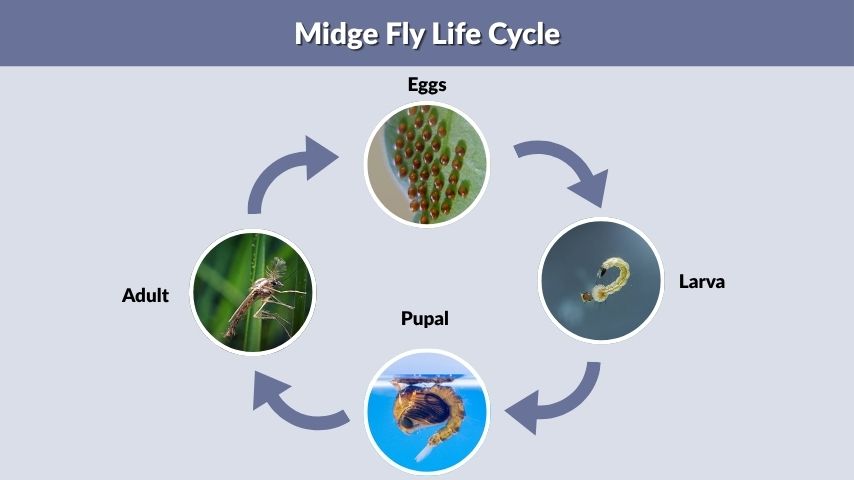
Midge flies go through complete metamorphosis. That means they develop through four main stages: egg, larva, pupa, and adult.
Egg Stage
Female midges lay eggs in or near suitable moist habitats. Non-biting midges often lay eggs on water surfaces or damp areas. Biting midges may use wet soil, marsh edges, mud, or moist organic material depending on the species.
The eggs hatch into larvae when conditions are right. Warm weather, moisture, and organic material can speed development.
Larval Stage
The larval stage is the main feeding stage. Larvae may feed on algae, bacteria, decaying plant material, organic particles, or small microorganisms. In aquatic environments, they may live in tubes or burrows in sediment.
This stage can be important ecologically because larvae recycle nutrients and support fish populations.
Pupal Stage
After growing enough, the larva becomes a pupa. The pupa is a transition stage between the worm-like larva and the flying adult. In aquatic species, pupae may rise toward the water surface before the adult emerges.
Adult Stage
Adult midges usually live for a short time. Their main purpose is reproduction. Many form swarms, especially in the evening, as part of mating behavior. After mating, females lay eggs and the cycle begins again.
Do Midge Flies Bite?
Some midges bite, but many do not. This is one of the most important distinctions.
Non-biting midges are nuisance insects. They may swarm, gather on buildings, and enter homes through screens or gaps, but they do not bite people. Biting midges, also called no-see-ums, punkies, or sand flies in some regions, can bite and cause itchy welts.
What Midge Fly Bites Feel Like
Biting midge bites may feel sharp, burning, or intensely itchy. Sometimes people do not notice the insect while it is biting because it is so small. Red bumps, irritation, and swelling may appear later.
Common bite symptoms include:
- Itchy red spots
- Small welts
- Burning sensation
- Local swelling
- Irritated skin after outdoor exposure
Avoid scratching because broken skin can become irritated or infected.
Midge Fly Bites: Basic Treatment
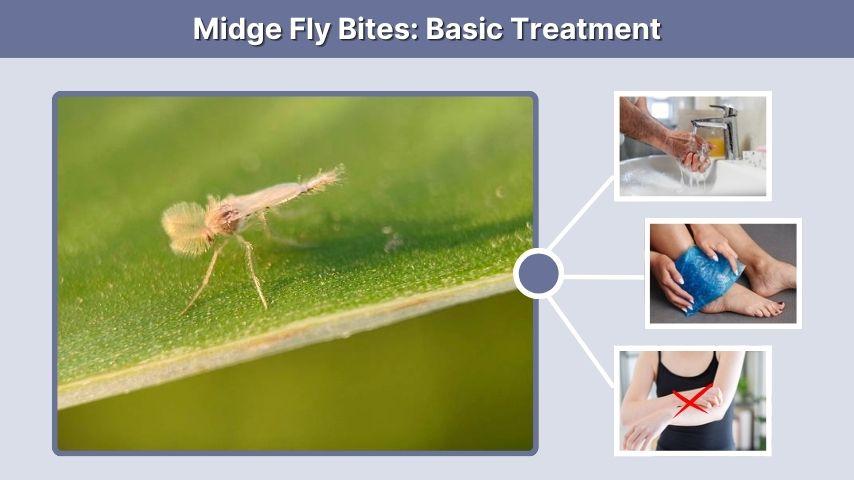
Most midge bites can be treated at home with simple care. Wash the area with soap and water, apply a cold compress, and avoid scratching. Over-the-counter anti-itch creams or oral antihistamines may help reduce discomfort.
Seek medical advice if swelling is severe, symptoms spread, signs of infection appear, or you experience an allergic reaction.
How to Reduce Bites Outdoors
To reduce biting midge exposure:
- Wear long sleeves and pants in problem areas.
- Use insect repellent according to label directions.
- Avoid peak biting times when possible.
- Use fans on patios because tiny flies struggle in airflow.
- Repair window screens and use fine mesh where needed.
- Reduce damp breeding areas near the home.
Biting midges are especially frustrating because they can pass through some ordinary screens. Fine mesh screening may be needed in severe areas.
Midge Fly Control
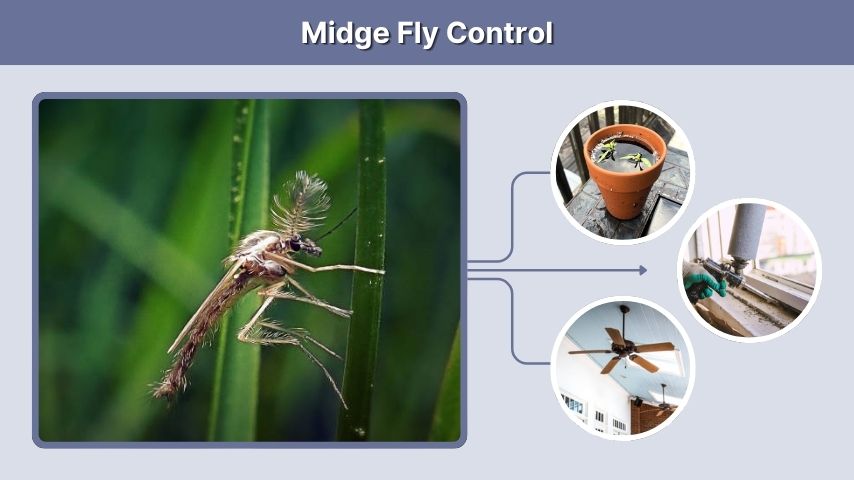
Midge fly control depends on whether you are dealing with non-biting midges, biting midges, or larvae. The best long-term approach is habitat reduction, moisture management, and exclusion.
Large adult swarms are often linked to nearby water or wet organic material. Because midges can fly from breeding sites, control may be difficult if the source is a lake, pond, marsh, or drainage system you do not manage.
How to Get Rid of Midge Flies Around the Home
Practical control steps include:
- Reduce standing water where possible.
- Clean clogged gutters.
- Remove decaying plant material.
- Improve drainage in wet areas.
- Keep outdoor lights off when not needed.
- Switch to less attractive outdoor lighting.
- Seal gaps around doors and windows.
- Use fine screens in problem areas.
- Use fans on patios and porches.
Adult midges are attracted to lights, so lighting changes can make a noticeable difference. Move bright lights away from doors, use shielded fixtures, or reduce unnecessary nighttime lighting.
Should You Use a Midge Fly Killer?
Insecticides may reduce adults temporarily, but they rarely solve the root problem if breeding sites remain. For non-biting midges, chemical control is often unnecessary unless swarms are severe. For biting midges, repellents and habitat management are usually more practical for personal protection.
If the problem is persistent and large-scale, professional pest control or local mosquito-control services may be needed.
Midge Flies in Florida
Midge flies are common in warm, humid regions, including Florida. Non-biting midges may swarm near lakes, canals, retention ponds, and homes near water. Biting midges are also a concern in coastal, marshy, and damp areas.
In Florida and similar climates, warm temperatures can support repeated generations. This means midge problems may last longer than in cooler regions, especially near permanent water or wet soil.
Why They Swarm Near Water
Many midges develop as larvae in aquatic or moist habitats. When adults emerge, they often gather near the same areas. Evening swarms are usually mating swarms, not an attack on people.
Although swarms can be annoying, non-biting midges are not trying to bite. They are simply reproducing and may be attracted to lights, buildings, and reflective surfaces.
EHD Midge Fly and Wildlife
Some biting midges are important because they can transmit diseases among animals. One commonly searched example is the EHD midge fly. EHD stands for epizootic hemorrhagic disease, a viral disease that affects deer, especially white-tailed deer.
The disease is associated with biting midges in the genus Culicoides. It is most often discussed in wildlife management because outbreaks can cause deer mortality in certain regions and seasons. This topic is different from ordinary non-biting midge swarms around porch lights.
Midge Fly Fishing
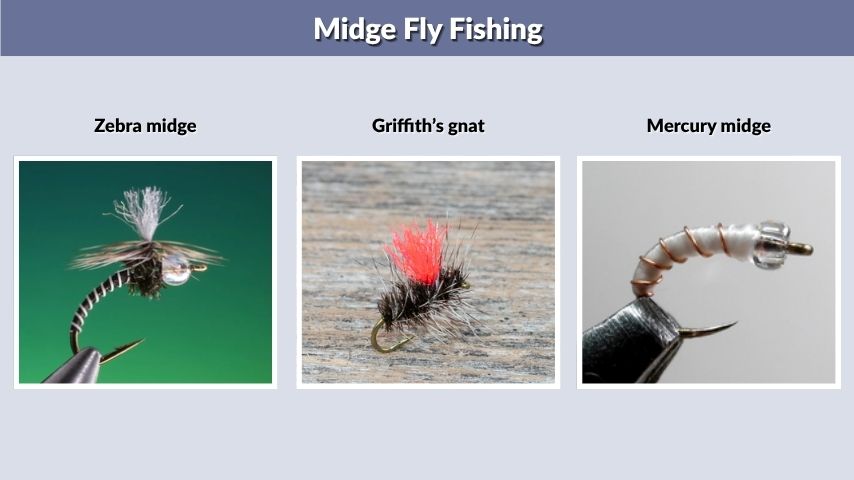
In fly fishing, “midge fly” often means an artificial fly pattern designed to imitate tiny aquatic midges. Midges are important trout food because their larvae and pupae are common in rivers, lakes, and tailwaters.
Midge patterns can imitate different stages:
- Larva
- Pupa
- Emerger
- Adult dry fly
Because natural midges are small, midge fly patterns are often tied in tiny sizes. They are especially useful in cold water, clear water, winter fishing, and pressured trout streams.
Popular Midge Fly Patterns
Common midge patterns include:
- Zebra midge
- Griffith’s gnat
- Mercury midge
- Top secret midge
- Disco midge
- Midge pupa
- Midge emerger
- Blood midge
- Black midge dry fly
The zebra midge fly pattern is one of the most widely known. It is simple, slim, and effective because it imitates small midge larvae or pupae drifting in the water.
Midge Dry Fly, Nymph, Pupa, and Emerger
Fly anglers often choose a pattern based on the midge stage trout are feeding on. A midge nymph or larva pattern is fished below the surface. A pupa pattern imitates the insect as it rises. An emerger pattern sits in or near the surface film. A midge dry fly imitates the adult stage on top of the water.
When to Use Each Type
Use a larva or nymph pattern when fish are feeding deep. Use a pupa pattern when midges are moving upward in the water column. Use an emerger when trout are sipping insects stuck in the surface film. Use a dry fly when adult midges are visible on the surface.
This stage-based approach is why fly-fishing searches include so many variations, such as midge dry fly patterns, midge pupa fly pattern, and midge emerger fly patterns.
Are Midge Flies Harmful?
Most non-biting midge flies are not harmful to humans. They are mainly a nuisance when they swarm, collect around lights, or leave dead insects on surfaces. Their larvae are often beneficial in aquatic ecosystems.
Biting midges are more troublesome because they can bite people and animals. Their bites can cause irritation, and some species can transmit diseases among animals. The level of concern depends on the species, location, and exposure.
FAQs
What is a midge fly?
A midge fly is a small fly that may look like a mosquito. Some midges do not bite and mainly swarm near water or lights. Others, called biting midges or no-see-ums, can bite people and animals. The term can also refer to aquatic insects important in fly fishing.
Do midge flies bite?
Some midge flies bite, but many do not. Non-biting midges are common around lights and water and do not feed on blood. Biting midges are much smaller and can leave itchy, red welts. Correct identification matters before choosing repellents or control methods.
What are midge fly larvae?
Midge fly larvae are the immature, worm-like stage of midges. They often live in water, mud, sediment, damp soil, or organic matter. Some red larvae are called bloodworms. These larvae are important food for fish and are also imitated by fly-fishing patterns.
How do you get rid of midge flies?
To reduce midge flies, remove standing water where possible, clean gutters, improve drainage, reduce outdoor lighting, seal gaps, and use fine screens. Fans can help on patios. If midges are breeding in a nearby lake or marsh, full control may require professional or community-level management.
What is the difference between a midge fly and a mosquito?
A mosquito usually has a long piercing mouthpart, and females commonly bite. Many midges do not bite and often form visible swarms near water or lights. Biting midges can bite, but they are usually much smaller than mosquitoes and are often called no-see-ums.