
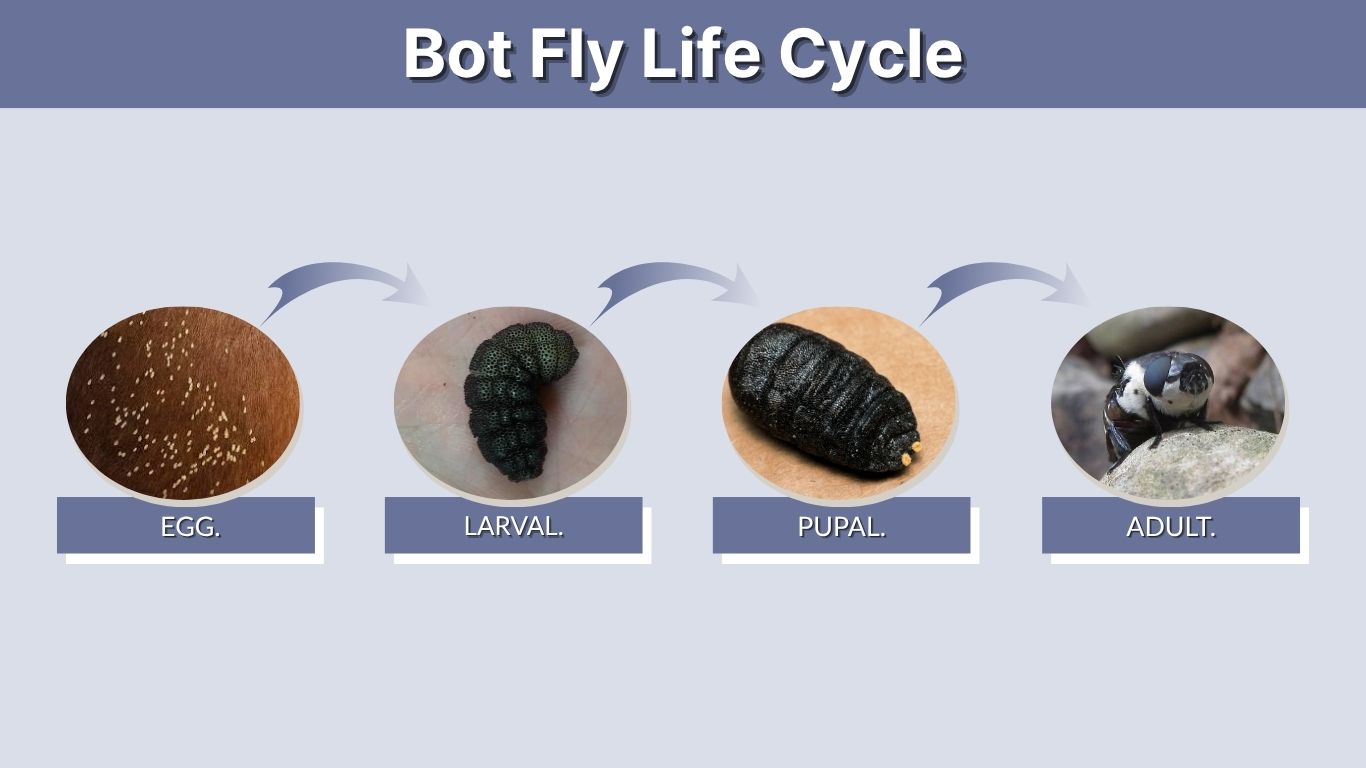
The bot fly life cycle includes four basic stages: egg, larva, pupa, and adult. However, the details differ considerably among human, rabbit, rodent, horse, and sheep bot flies. Some species attach eggs to mosquitoes, while others place eggs on animal hair or vegetation. Their larvae may develop beneath the skin, inside the stomach, or within nasal passages. Understanding these differences explains how humans and animals become infested, how long larvae remain in a host, and where prevention can interrupt the cycle.
The Four Main Bot Fly Life Cycle Stages
All bot flies undergo complete metamorphosis. This means the immature larva looks and behaves very differently from the winged adult. The host-dependent larval stage is the longest and most important part of the cycle.
1. Egg or Larval Deposition
After mating, the female must place her offspring where they can reach an appropriate host. The method depends on the species:
- Human bot flies attach eggs to mosquitoes or other blood-feeding arthropods.
- Rabbit and rodent bot flies lay eggs around burrows and animal trails.
- Horse bot flies glue their eggs to the horse’s hair.
- Sheep nasal bot flies deposit living larvae near the nostrils instead of laying eggs there.
The warmth, moisture, movement, or grooming behavior of a host stimulates the eggs to hatch.
2. Larval Entry
Newly hatched larvae are extremely small. They enter the host through the skin, mouth, nose, an existing wound, or another natural opening.
Human bot fly larvae usually transfer when an infected mosquito lands on a person. Rabbit and rodent bot larvae reach animals after eggs hatch on vegetation near burrows. Horse bot larvae enter the mouth when a horse licks or bites areas containing eggs.
3. Larval Development
The larva passes through three growth stages called instars. Depending on the bot fly species, it develops:
- Beneath the skin
- Inside a skin cyst or warble
- Within the mouth and stomach
- In nasal passages and sinuses
- Occasionally in an abnormal organ or body cavity
Larvae feed on fluids, tissue secretions, or material available at their attachment site. As they grow, their bodies become thicker and develop spines that help anchor them to the host.
4. Exit, Pupation, and Adult Emergence
A mature larva eventually leaves the host, falls to the ground, and burrows into soil or debris. There it forms a protective pupal case.
During pupation, its body transforms into an adult fly. The adult then emerges, mates, and begins another generation. Many adult bot flies live only briefly and focus primarily on reproduction.
Human Bot Fly Life Cycle
The human bot fly, Dermatobia hominis, occurs mainly from Mexico through Central and South America. Despite its common name, it can develop in many mammals, not just humans.
Eggs Are Carried by Another Insect
A female human bot fly catches a mosquito, tick, or another blood-feeding arthropod and attaches eggs to its body with a glue-like material. The carrier then transports the eggs to a suitable mammalian host.
The adult bot fly itself does not have to land on or bite the person. This unusual relationship allows the eggs to reach a host without exposing the large adult fly.
Larvae Enter and Develop Beneath the Skin
When the carrier lands to feed, the host’s body heat stimulates the eggs. The larvae hatch and enter through the carrier’s bite wound, a hair follicle, or nearby skin.
Each larva develops in a cavity beneath the skin while maintaining a small breathing hole at the surface. A raised, boil-like lesion gradually forms and may produce pain, itching, discharge, or a sensation of movement.
Human bot fly larvae remain beneath the skin for approximately five to ten weeks. When mature, they crawl out, fall to the ground, and pupate. An adult can emerge after roughly one month under suitable conditions.
Rabbit and Rodent Bot Fly Life Cycle
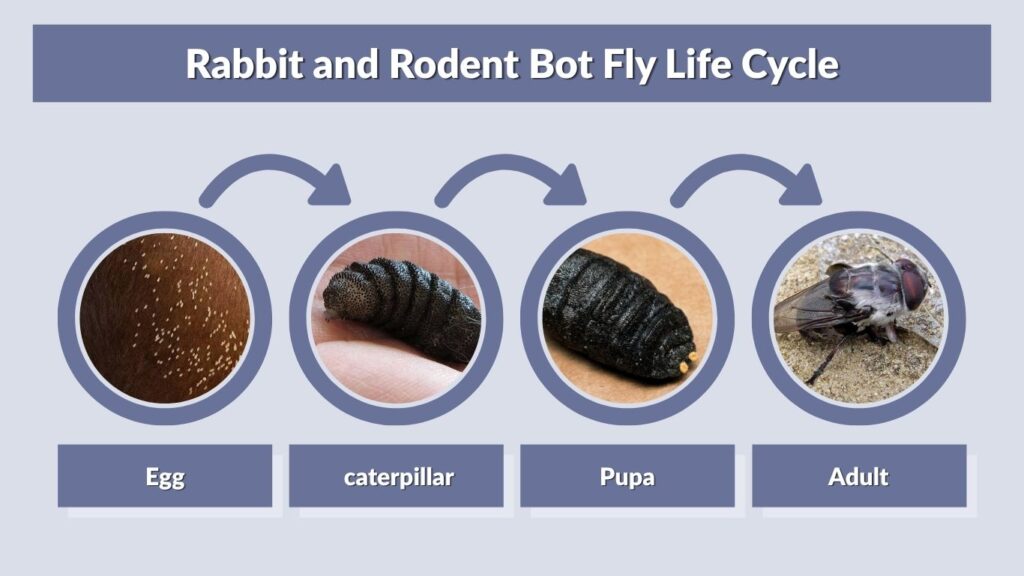
Species in the genus Cuterebra primarily parasitize rabbits, squirrels, mice, rats, chipmunks, and other small mammals. Their larvae produce swellings commonly called warbles or wolves.
Eggs Around Burrows
Adult females lay groups of eggs on grass, bark, wood chips, stones, and other objects near rodent or rabbit burrows. Heat from a passing animal stimulates the eggs to hatch.
The tiny larvae attach to the animal’s coat and generally enter through its nose, mouth, or another natural opening. Skin penetration is not their usual entry method.
Migration and Warble Formation
After entering, the larvae migrate through the host before reaching a species-specific location beneath the skin. A breathing pore develops as the larva grows inside the warble.
In a normal rabbit or rodent host, the mature larva leaves through this opening, drops to the ground, and pupates. Depending on the species and environmental conditions, an adult may emerge several months later or remain in the pupal stage through an unfavorable season.
Bot Fly Life Cycle in Dogs and Cats
Dogs and cats are accidental hosts for rabbit and rodent bot flies. Outdoor pets are most likely to encounter eggs while hunting or investigating wildlife habitats.
What Happens Inside a Pet?
The early larva generally enters through the mouth or nose and migrates through the body. If it reaches the skin successfully, it creates a lump with a central breathing pore. Common locations include the head, neck, shoulders, and trunk.
In some cases, the larva migrates abnormally into the eye, respiratory tract, brain, or spinal cord. This can cause coughing, breathing difficulty, balance problems, seizures, vision changes, or other serious symptoms.
Can the Cycle Finish in a Dog or Cat?
A mature larva may leave a pet and pupate in the soil, but dogs and cats are not the normal hosts. Abnormal migration and complications are consequently more likely than they are in rabbits or rodents.
A veterinarian should remove a visible larva intact. Squeezing a warble can rupture the larva, potentially causing inflammation, infection, or a serious allergic reaction.
Horse Bot Fly Life Cycle
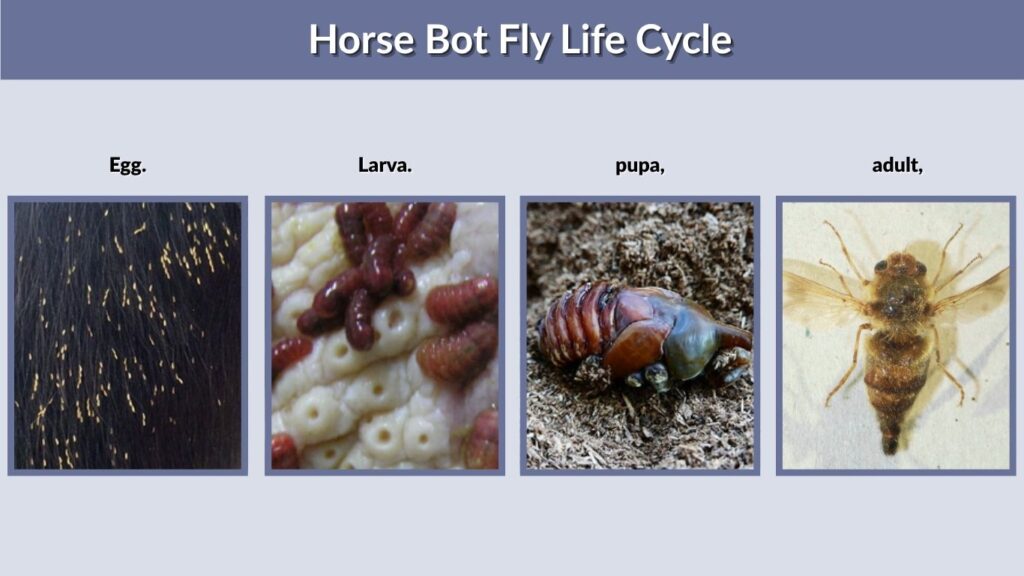
Horse bot flies belong to the genus Gasterophilus. Unlike human and rabbit bot flies, their larvae usually develop in the horse’s digestive system rather than beneath its skin.
From the Coat to the Mouth
The female glues small eggs to individual hairs. Egg placement varies by species, but common areas include the legs, neck, shoulders, jaw, and face.
Licking or grooming stimulates some eggs to hatch. The larvae enter the horse’s mouth and spend several weeks migrating through tongue tissue or remaining around the teeth and gums.
Development in the Stomach
After approximately four weeks in the mouth, the larvae move to the stomach. They attach to the stomach lining and develop into later instars.
Horse bot larvae can remain inside the animal for eight to ten months. Mature larvae detach, pass out in manure, and pupate in the soil. Adults generally emerge after a pupal period of approximately three to five weeks.
Sheep Nasal Bot Fly Life Cycle
The sheep nasal bot fly, Oestrus ovis, has a distinctive life cycle because the female gives birth to living larvae instead of depositing eggs on the animal.
Larvae in the Nose and Sinuses
The female flies near a sheep or goat and sprays tiny larvae around its nostrils. These larvae crawl into the nasal passages and may migrate into the sinuses.
They develop there for one to ten months, depending on climate, season, and host conditions. Infested animals may sneeze, shake their heads, develop nasal discharge, or have difficulty grazing comfortably.
When mature, the larvae leave the nose, fall to the ground, and pupate beneath the soil. Adults normally emerge three to nine weeks later.
How Long Does the Bot Fly Life Cycle Take?
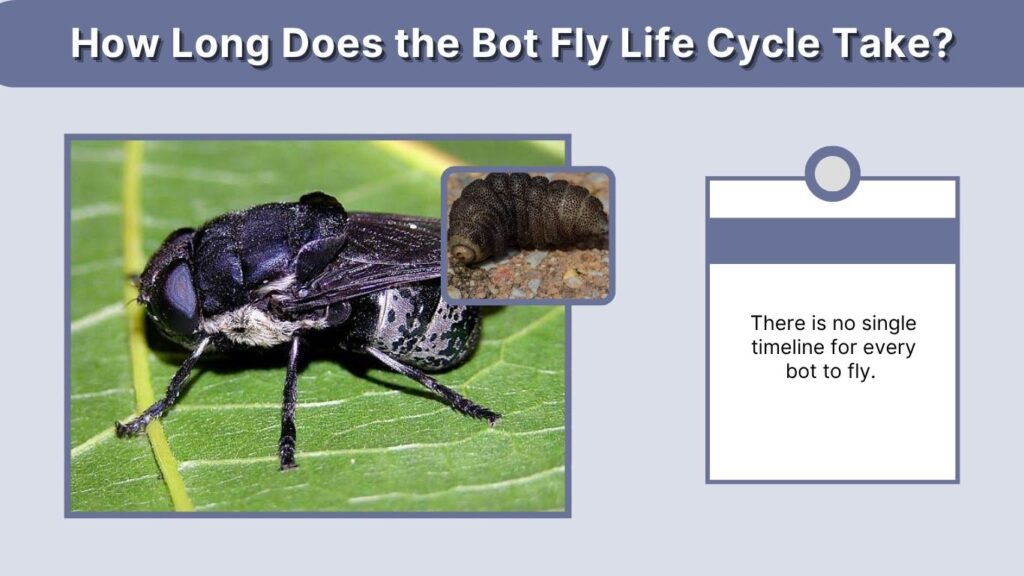
There is no single timeline for every bot to fly. Temperature, climate, species, and host suitability all affect development.
| Bot fly type | Main larval location | Approximate larval period |
| Human bot fly | Beneath the skin | 5–10 weeks |
| Rabbit or rodent bot fly | Subcutaneous warble | Often several weeks |
| Horse bot fly | Mouth and stomach | Up to 8–10 months |
| Sheep nasal bot fly | Nose and sinuses | 1–10 months |
The pupal stage may last several weeks, months, or longer. Species in seasonal climates can delay adult emergence until environmental conditions become favorable.
Breaking the Bot Fly Life Cycle
Control works best before larvae enter a host or before mature larvae reach the soil and pupate.
- Use insect repellent and protective clothing in bot fly regions.
- Protect and clean open wounds.
- Reduce mosquito exposure during tropical travel.
- Keep dogs and cats away from rabbit and rodent burrows.
- Inspect outdoor pets regularly for lumps with central pores.
- Remove bot fly eggs from horses using appropriate grooming tools.
- Follow a veterinarian-approved parasite-control program.
- Dispose of professionally removed larvae so they cannot pupate.
- Maintain clean livestock housing and manage manure properly.
FAQs
What are the four stages of a bot fly?
The four basic stages are egg, larva, pupa, and adult. Sheep nasal bot flies are an exception because females deposit living larvae.
How long does a human bot fly live beneath the skin?
A human bot fly larva normally develops beneath the skin for approximately five to ten weeks before emerging.
Can bot flies complete their life cycle in dogs?
Some larvae can grow beneath a dog’s skin and eventually emerge, but dogs are accidental rather than normal hosts for Cuterebra species.
Do bot flies lay eggs directly on humans?
Human bot flies usually attach eggs to mosquitoes or other blood-feeding arthropods. The carrier transports the eggs to a person or another mammal.
Does removing a larva stop the life cycle?
Removing and destroying the entire larva prevents that individual from reaching the pupal and adult stages. Professional removal is recommended because squeezing can rupture it beneath the skin.