
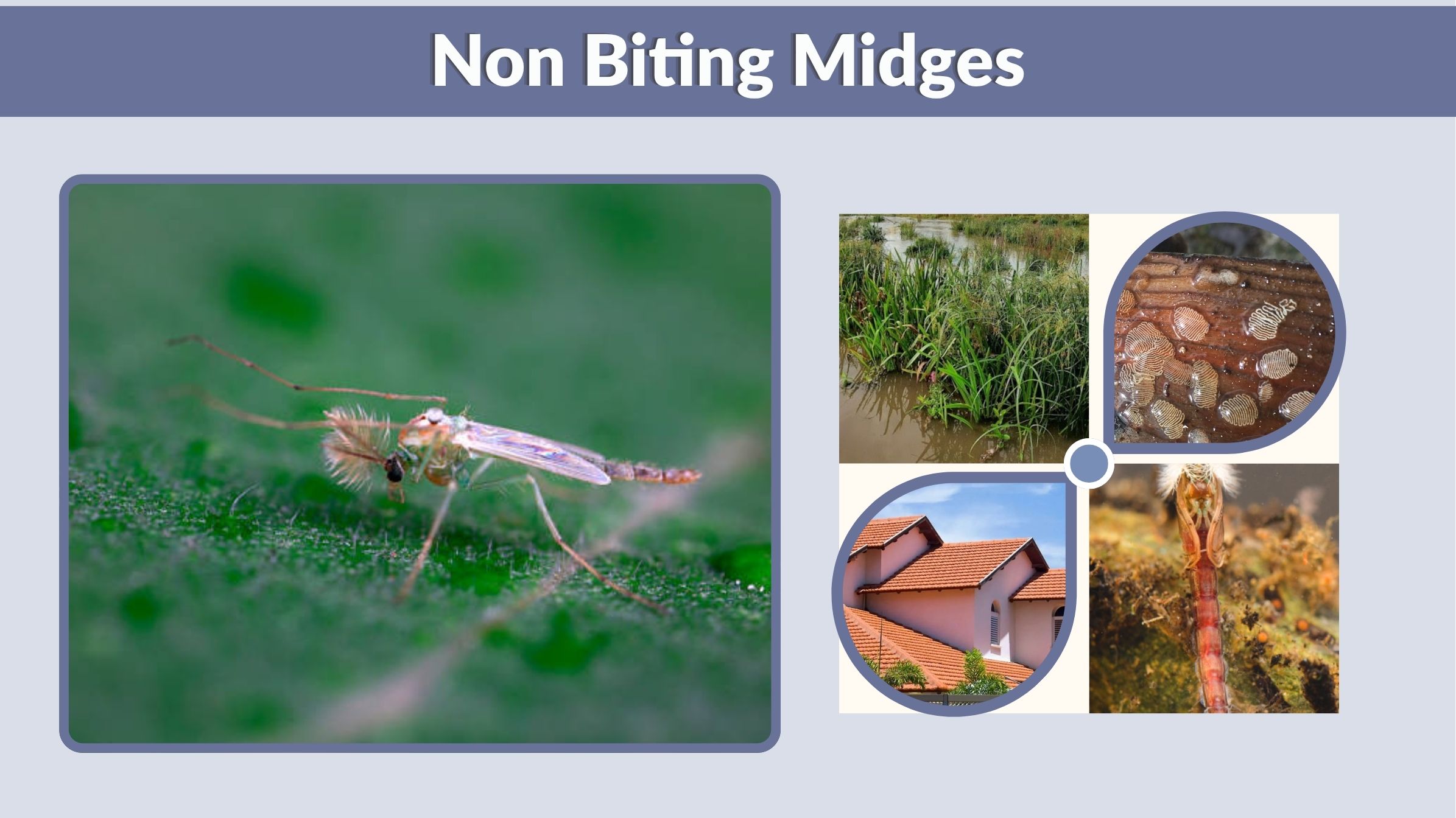
Non biting midges are small mosquito-like flies that often appear in large swarms near lakes, ponds, wetlands, and outdoor lights. Although they look alarming, they do not bite people or pets. Most problems come from nuisance swarms, insects entering houses, and adults covering walls, windows, boats, or patios. Understanding their life cycle and habitat makes control much easier.
What Are Non Biting Midges?
Non biting midges are small flies from the family Chironomidae. They are also called chironomid midges, lake flies, blind mosquitoes, or aquatic midges. These insects are common around freshwater areas because their larvae usually develop in mud, sediment, or organic material at the bottom of ponds, lakes, drainage areas, and slow-moving water.
The name can be confusing because “midge” is used for several tiny flies. Some midges bite, but non biting midges do not. They lack the piercing mouthparts needed to take blood. Adults may look similar to mosquitoes, but they are mostly a nuisance rather than a direct health threat.
Non biting midges are important in nature. Their larvae help break down organic matter in water, and they are food for fish, birds, bats, dragonflies, and other wildlife. Problems happen when large numbers emerge at once and gather around homes, businesses, lights, porches, vehicles, or lakefront structures.
Non Biting Midge Identification
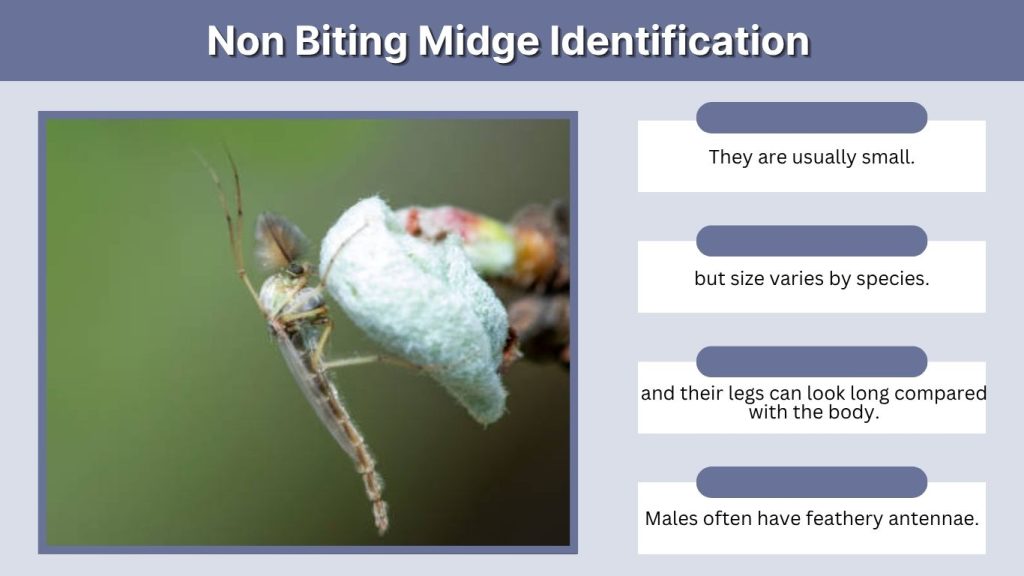
Adult non biting midges are delicate, thin-bodied flies. They are usually small, but size varies by species. Many are pale green, tan, gray, brown, or dark. Their wings are clear, and their legs can look long compared with the body. Males often have feathery antennae, while females have thinner antennae.
The easiest way to identify them is by behavior. They often rest on walls, screens, windows, doors, boats, and vegetation near water. At night, they gather around porch lights, streetlights, security lights, and illuminated windows.
| Feature | Non biting midge | Mosquito | Biting midge |
| Bites humans | No | Yes, females of many species | Yes, some species |
| Main issue | Nuisance swarms | Bites and disease risk | Painful bites |
| Larval habitat | Aquatic mud or sediment | Standing water | Wet soil, mud, marshes, or organic areas |
| Appearance | Mosquito-like, delicate body | Longer proboscis, scaled wings | Very tiny, often hard to see |
| Attraction to lights | Strong | Variable | Often active near dusk |
Non Biting Midge vs Mosquito
Non biting midges are often mistaken for mosquitoes because both are small flies with long legs. The difference is that mosquitoes have a noticeable proboscis used for feeding, while non biting midges do not bite. Mosquito wings also have scales, while midge wings are generally clearer and lack the same scaled appearance.
Behavior is another clue. Mosquitoes often seek people or animals for blood meals. Non biting midges usually swarm, rest on surfaces, or cluster around lights without trying to bite.
Biting Midge vs Non Biting Midge
Biting midges are different insects. They may be called no-see-ums, punkies, or sand flies in some regions. These tiny flies can bite and cause itchy welts. Non biting midges may be annoying in huge numbers, but they do not feed on blood.
If insects are biting ankles, arms, face, or neck, the problem is probably not Chironomidae non biting midges. It may involve mosquitoes, biting midges, black flies, fleas, or another biting pest.
Non Biting Midge Larvae
Non biting midge larvae are aquatic or semi-aquatic. They live in ponds, lakes, ditches, marshes, streams, stormwater systems, and other moist habitats. Many larvae live in soft sediment where they feed on algae, bacteria, decaying plant matter, and tiny organic particles.
Some larvae are red and are often called bloodworms. The red color comes from hemoglobin-like compounds that help them survive in low-oxygen water. These larvae are a valuable food source for fish and are sometimes used in aquariums or fishing.
What Do Non Biting Midge Larvae Eat?
Most non biting midge larvae feed on organic matter, algae, microorganisms, and detritus. Their feeding helps recycle nutrients in aquatic environments. In healthy ecosystems, they are part of the natural food web rather than a pest that needs total elimination.
However, nutrient-rich water with heavy organic buildup can support large larval populations. When conditions are right, many adults may emerge at the same time and create nuisance swarms.
Non Biting Midge Life Cycle
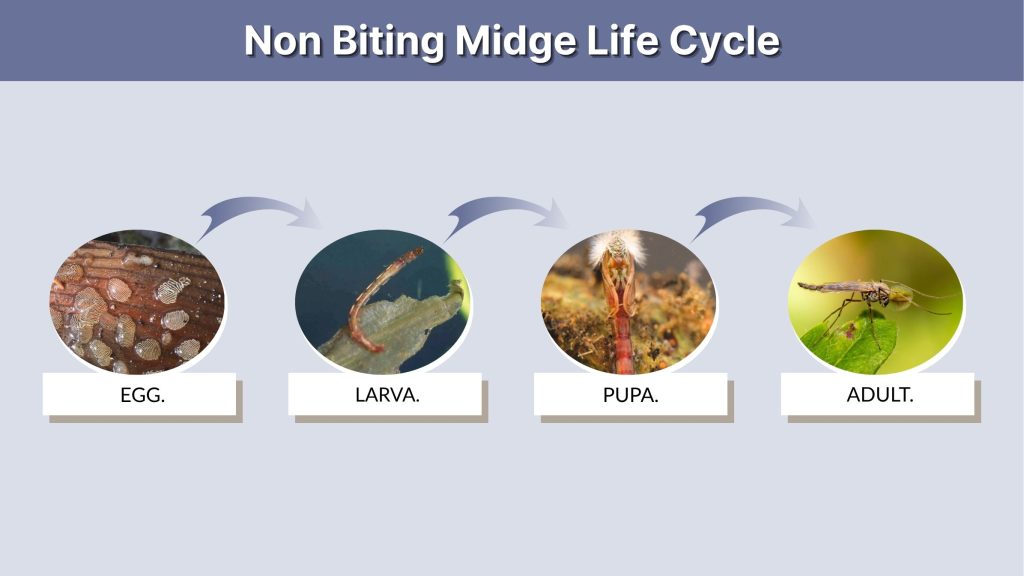
The non biting midge life cycle has four stages: egg, larva, pupa, and adult. The cycle begins when females lay eggs on or near water. After hatching, larvae settle into mud, sediment, plants, or organic debris. They feed and grow before becoming pupae. Adults then emerge from the water and fly away.
In warm conditions, development can be fast. In cooler weather, larvae may develop more slowly. Some species produce several generations each year, especially in areas with warm climates and stable aquatic habitats.
The adult stage is usually short. Adults often live only long enough to mate and lay eggs. This explains why swarms can appear suddenly and then decline, only to return again when the next generation emerges.
Why Non Biting Midges Form Swarms
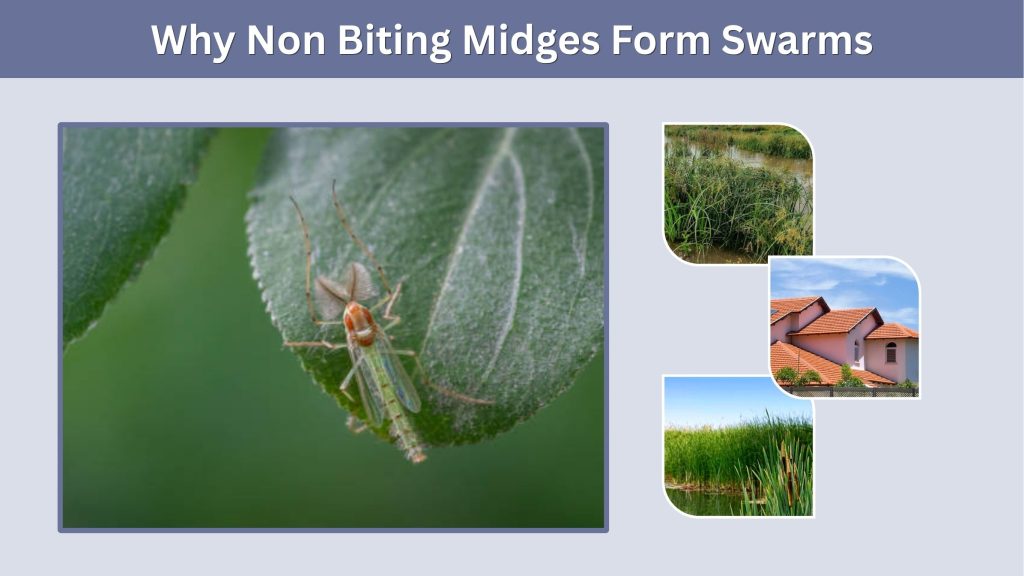
Non biting midge swarms are usually mating groups. Males gather in clouds, often near landmarks such as trees, roofs, walls, shoreline vegetation, or lights. Females enter the swarm to mate. These swarms can be large, especially near productive water bodies.
Swarms are more common when weather is calm and humid. They may be worse around sunset, at night, or near bright outdoor lighting. Lakefront homes, restaurants, marinas, parks, and waterfront businesses often notice the heaviest activity.
Common swarm triggers include:
- Nearby ponds, lakes, wetlands, or drainage canals
- Warm weather and high humidity
- Outdoor lights at night
- Nutrient-rich water with organic sediment
- Calm evenings with little wind
- Seasonal adult emergence after larval development
Non Biting Midges in the House
Non biting midges can enter houses through open doors, damaged screens, vents, window gaps, and bright entryways. They do not infest furniture, clothing, food, or bedding like some household pests. Usually, they are coming from outside and are attracted indoors by light.
Inside the house, they may gather around lamps, windows, ceilings, or walls. Dead midges can collect on windowsills and floors. Large numbers may be unpleasant, but they are not breeding indoors unless there is a suitable wet habitat nearby.
To reduce indoor problems, focus on exclusion and lighting. Repair screens, seal gaps, keep doors closed during peak activity, and reduce bright white lights near entrances.
Are Non Biting Midges Dangerous?
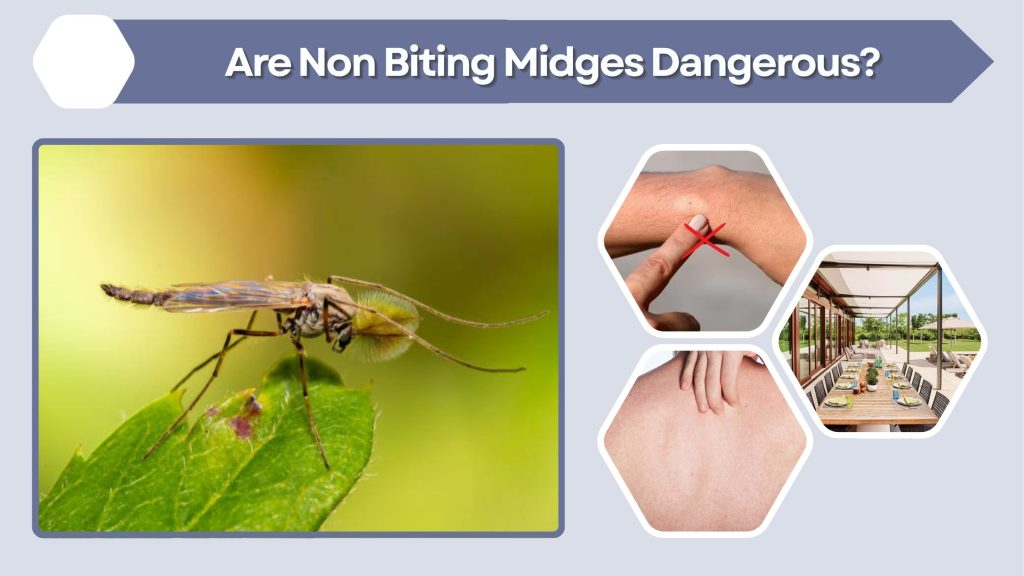
Non biting midges are not considered dangerous to humans because they do not bite or suck blood. They are not known as major disease transmitters like mosquitoes. Their main impact is nuisance.
However, large numbers can still create problems. Dead midges may stain surfaces, trigger allergies in sensitive people, contaminate outdoor dining areas, or create slippery piles on walkways. In lakefront communities, heavy midge emergence can affect comfort, tourism, and outdoor activities.
Pets are generally not at risk from bites because these insects do not bite. Still, large swarms can irritate animals by flying around their eyes, ears, or resting areas.
Non Biting Midges Season
Non biting midge season depends on location, climate, and water conditions. In many regions, activity increases during spring, summer, and early fall. Warm areas may see activity for much of the year. Cooler areas often see noticeable emergence during warmer months.
Swarms may appear in waves. One week may bring thousands of adults, followed by a quieter period. Then another generation may emerge. This cycle makes control frustrating because adults can keep appearing from the same water source.
Areas near lakes, reservoirs, retention ponds, and slow-moving water are more likely to have repeated seasonal problems.
How to Get Rid of Non Biting Midges
Getting rid of non biting midges requires realistic expectations. Since larvae develop in water and adults fly from nearby aquatic sources, total elimination is rarely possible. The goal is to reduce attraction, block entry, manage breeding areas when possible, and lower nuisance levels.
Reduce Outdoor Lighting
Light management is one of the most practical control methods. Non biting midges are strongly attracted to bright lights, especially near water.
Helpful steps include:
- Turn off unnecessary outdoor lights during peak midge season.
- Replace bright white bulbs with warmer, less attractive lighting.
- Move lights away from doors, patios, and seating areas.
- Use motion-sensor lights instead of lights that stay on all night.
- Close curtains or blinds so indoor lights do not attract insects to windows.
Keep Midges Out of the House
Physical exclusion helps prevent indoor nuisance problems. Since adult midges are small, even minor gaps can let them in.
Useful steps include:
- Repair torn window and door screens.
- Add weatherstripping around doors.
- Keep doors closed during evening swarms.
- Seal gaps around vents, pipes, and window frames.
- Use fine mesh where midge pressure is heavy.
Manage Nearby Water Sources
Larval control is more complicated because larvae live in aquatic habitats. Small backyard ponds may be manageable, but large lakes, canals, or wetlands are difficult to treat and may be regulated.
For private ponds, improving water quality can help reduce excessive larval production. Remove excess organic debris, avoid fertilizer runoff, maintain healthy aeration, and support fish that feed on larvae. In some situations, professional aquatic pest management may be needed.
Do not apply pesticides to ponds, lakes, or drainage areas unless the product is labeled for aquatic use and local rules allow it.
Use Fans and Surface Cleaning
Fans can help around patios, porches, and outdoor seating areas because midges are weak fliers. A steady airflow makes it harder for them to gather.
Cleaning is also important during heavy emergence. Rinse walls, windows, boats, and outdoor furniture regularly to prevent buildup. Dead insects can stick to surfaces and become harder to remove if left for too long.
Non Biting Midge Control Outdoors
Outdoor control works best when several methods are combined. Spraying adults may provide short-term relief, but it often does not solve the source problem. More adults can emerge from nearby water soon after treatment.
For homes and businesses, the best outdoor strategy includes light reduction, exclusion, sanitation, fans, and water-source management. For large community problems, lake associations, municipalities, or pest professionals may need to evaluate breeding sites and environmental conditions.
Avoid overusing broad insecticides. These may harm beneficial insects and natural predators while giving only temporary control of adult midges.
Non Biting Midges and Fish
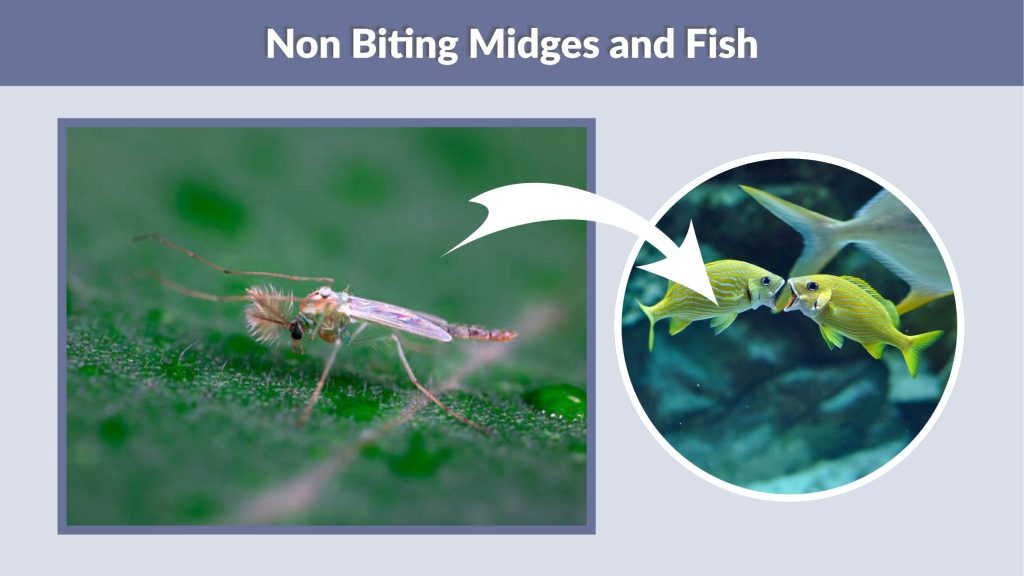
Non biting midge larvae are an important food for fish. In ponds, insect-eating fish can help reduce some larvae, although they may not eliminate the problem completely. Larvae live in sediment and organic material, so fish access depends on pond conditions and fish species.
For aquarium or fish-feeding searches, “bloodworms” often refer to red chironomid larvae. They are commonly used as fish food. However, larvae collected from unknown outdoor water may carry contaminants, parasites, or pollutants, so commercially prepared fish food is safer for most aquariums.
FAQs
What is a non biting midge?
A non biting midge is a small fly in the family Chironomidae. It looks similar to a mosquito but does not bite humans or pets. These insects usually develop in aquatic habitats, then emerge as adults and gather near lights, walls, windows, and vegetation close to water.
Do non biting midges bite humans?
No, non biting midges do not bite humans. They lack the piercing mouthparts needed to take blood. If tiny flies are biting you, they are probably mosquitoes, biting midges, black flies, or another pest. Non biting midges are mainly a nuisance because they swarm in large numbers.
How do I get rid of non biting midges in the house?
To get rid of non biting midges in the house, reduce light attraction and block entry points. Repair screens, seal gaps, keep doors closed at night, and use warmer outdoor bulbs. Vacuum indoor midges and clean windowsills. The real source is usually nearby water, not an indoor infestation.
Are non biting midge larvae harmful?
Non biting midge larvae are not usually harmful to people. They live in water, mud, or sediment and feed on algae, bacteria, and organic matter. In nature, they help recycle nutrients and provide food for fish. Problems occur when large larval populations produce heavy adult swarms.
What attracts non biting midges?
Non biting midges are attracted to water sources, organic-rich sediment, humid weather, calm evenings, and artificial lights. Homes near lakes, ponds, drainage canals, or wetlands often see more activity. Bright porch lights, security lights, and illuminated windows can pull adult midges toward buildings at night.