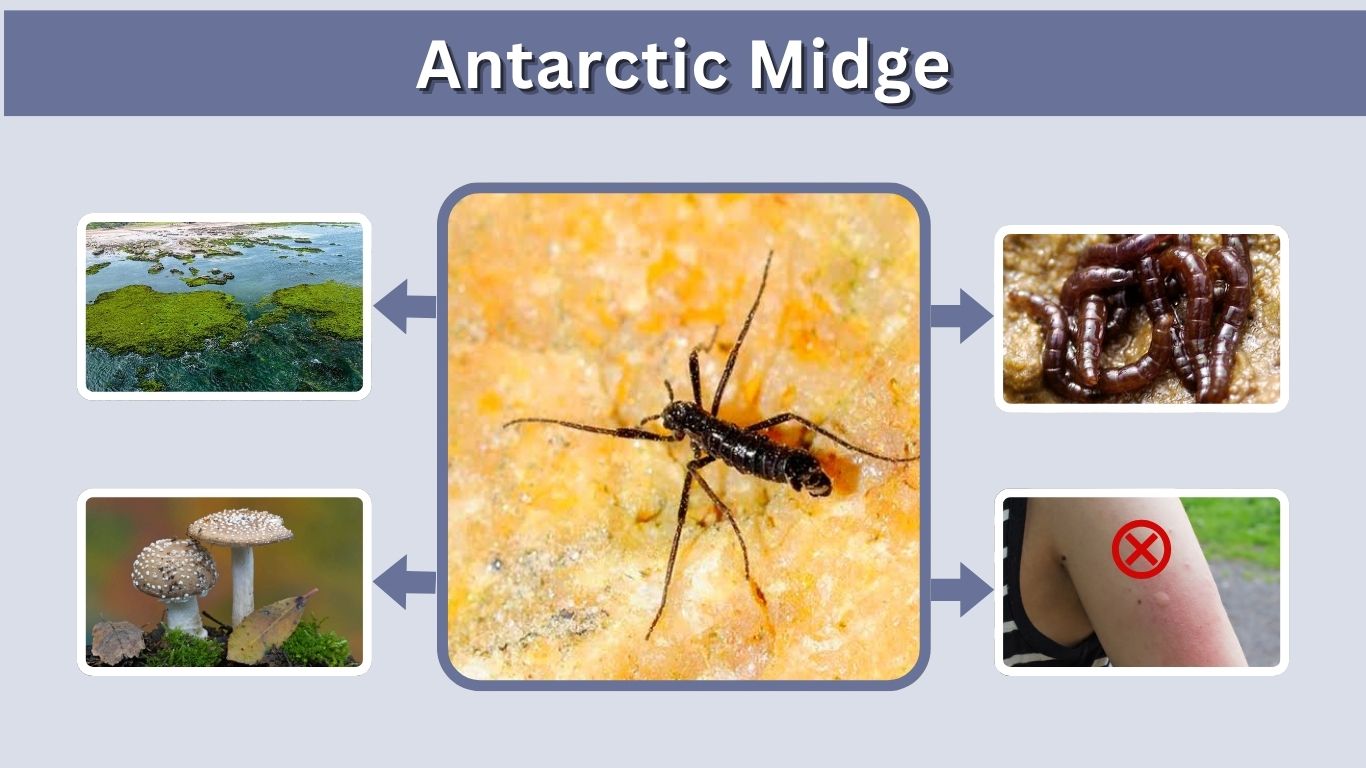
The Antarctic midge is one of the most unusual insects on Earth. Known scientifically as Belgica antarctica, this tiny, wingless fly survives in a place where most insects cannot live at all. It is small enough to sit on a fingernail, yet it holds a remarkable title as Antarctica’s largest purely land-dwelling native animal. Its life is shaped by freezing temperatures, dehydration, short summers, and extreme survival adaptations.
What Is the Antarctic Midge?
The Antarctic midge is a small, flightless insect in the family Chironomidae. Chironomids are often called non-biting midges, and many species around the world look similar to mosquitoes. The Antarctic midge is different because it lives in one of the harshest habitats on the planet and has lost the ability to fly.
This insect is found on the Antarctic Peninsula and nearby islands. Unlike penguins and seals, which depend heavily on the ocean, the Antarctic midge spends its life on land. That makes it especially important when discussing Antarctica’s true terrestrial wildlife.
Scientific Name and Basic Identity
- Common name: Antarctic midge
- Scientific name: Belgica antarctica
- Family: Chironomidae
- Order: Diptera
- Type: Flightless non-biting midge
- Native range: Antarctica
- Adult size: About 2–6 mm
- Wings: Reduced or absent for flight
- Human danger: Not dangerous and does not bite people
The species was named after the Belgian Antarctic Expedition, which collected important early Antarctic specimens. Its scientific name reflects that history and its connection to the Antarctic region.
Why It Is So Famous
The Antarctic midge is famous because it survives where insects are usually absent. Antarctica is cold, dry, windy, and exposed to strong seasonal changes. Most insects cannot complete a life cycle there, but this midge has evolved strategies that allow it to live through long winters and brief summers.
It is also famous because of its size record. At only a few millimeters long, it may sound unimpressive, but Antarctica has very few true land animals. In that context, the Antarctic midge becomes one of the continent’s most important terrestrial species.
Antarctic Midge Size and Appearance
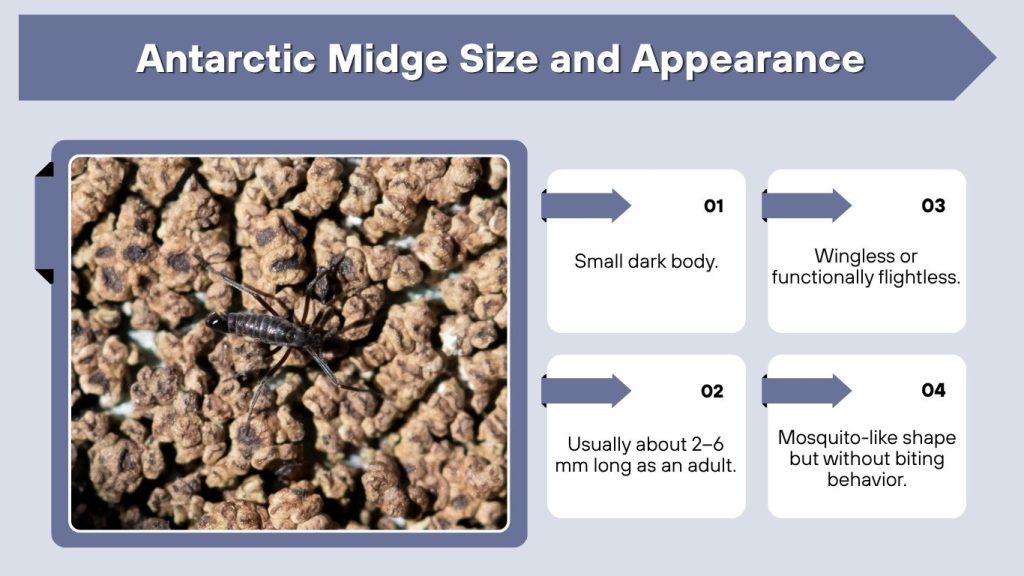
The Antarctic midge is tiny, dark, and simple-looking. It does not have the colorful wings or bold markings seen in many other insects. Its body is built for survival rather than display.
Adult midges are usually only a few millimeters long. The larvae can be slightly longer than adults and are the stage most involved in long-term survival. Adults live briefly and focus mainly on reproduction.
Identification Features
- Small dark body
- Usually about 2–6 mm long as an adult
- Wingless or functionally flightless
- Mosquito-like shape but without biting behavior
- Long, thin legs
- Soft body suited to moist microhabitats
- Larvae are worm-like and live in protected damp areas
- Adults appear during the short Antarctic summer
The absence of working wings is one of the most important features. In Antarctica, wings can be more dangerous than useful. Strong winds could blow a flying insect away from suitable habitat and into areas where it cannot survive.
Why the Antarctic Midge Is Wingless
Flightlessness is likely an advantage in Antarctica. Flying insects need energy, warm conditions, and safe airspace. The Antarctic midge lives in a windy, cold environment where flight could be risky.
By losing flight ability, the midge avoids being carried away by strong winds. It also saves energy that can be used for survival and reproduction. Its body is compact and adapted to life close to the ground, where conditions are slightly more stable than in open air.
Is It a Mosquito?
The Antarctic midge is not a mosquito. It belongs to a related group of flies, but it does not bite humans or feed on blood. Many non-biting midges resemble mosquitoes, which can cause confusion.
The easiest difference is behavior. Mosquitoes often seek blood meals, while the Antarctic midge is not a blood-feeding insect. Its larvae feed on organic material and microorganisms, while adults have a very short life focused on mating and egg-laying.
Where the Antarctic Midge Lives
The Antarctic midge does not live across every part of Antarctica. It is mainly associated with ice-free areas of the Antarctic Peninsula and nearby islands. These small land zones provide enough moisture, organic matter, and shelter for its life cycle.
Antarctica is not only cold; it is also extremely dry. The midge survives by using tiny protected microhabitats where conditions are less severe than the open landscape.
Habitat and Distribution
The Antarctic midge lives in moist terrestrial habitats, especially places with algae, mosses, organic debris, and bird-influenced soils. These areas may occur near rocky coastal sites, seabird colonies, penguin rookeries, or protected patches where snowmelt creates temporary moisture.
It does not need large forests, grasses, or rich soil. Instead, it uses miniature ecosystems that form during the short summer. Even a thin layer of damp organic material can become useful habitat.
Why Antarctica Is So Difficult for Insects
Antarctica creates several problems for insects. Temperatures can remain below freezing for long periods. Liquid water is limited. Food is scarce. Winds are strong. The growing season is short. Ultraviolet radiation can also be intense in exposed areas.
Most insects need warm periods to feed, grow, mate, and lay eggs. The Antarctic midge solves this by spending most of its life as a larva and developing slowly over time.
Life Close to the Ground
The midge survives by staying close to the surface or slightly below it. Soil, moss, algae mats, rocks, snow cover, and organic debris can buffer temperature changes. A few centimeters of protection can make a major difference.
This low-level lifestyle helps the insect avoid the worst wind exposure and temperature swings. It is a tiny animal living in tiny spaces, but those small spaces are enough for survival.
What Do Antarctic Midges Eat?
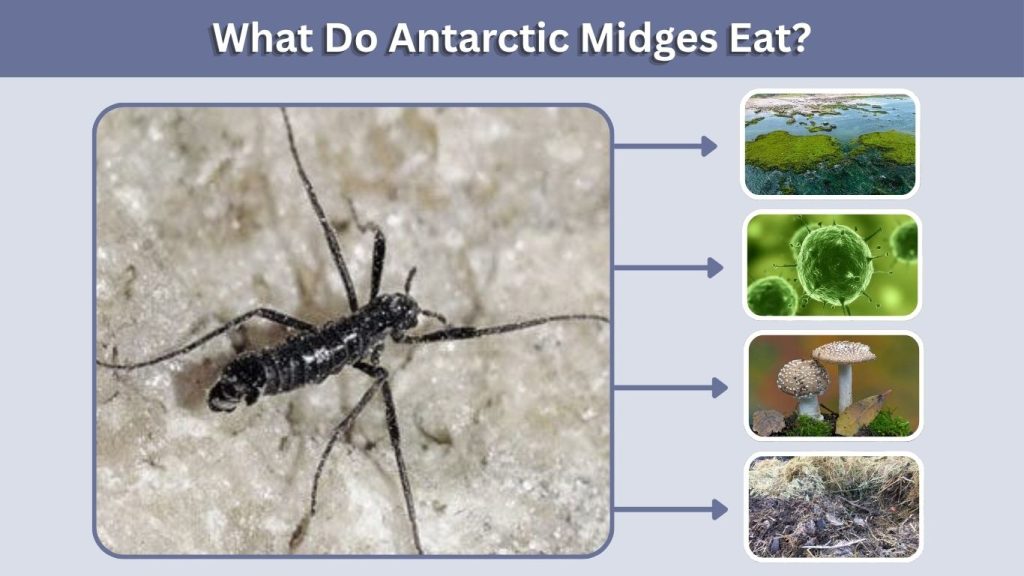
The Antarctic midge does not hunt like a predator. Its larvae feed mainly on simple organic resources found in their environment. These include algae, moss-associated material, microorganisms, fungi, and decaying organic matter.
Food is limited in Antarctica, so the larvae must use what is available. Their diet fits the sparse terrestrial ecosystem.
Antarctic Midge Diet
- Algae
- Microorganisms
- Fungi
- Decaying plant-like material
- Organic debris
- Nutrient-rich material around bird colonies
- Moist biofilms in protected habitats
Larvae do most of the feeding. Adults live briefly and may not feed much or at all. Their main role is reproduction.
Role in the Ecosystem
The Antarctic midge helps break down organic matter and recycle nutrients in small land ecosystems. Its larvae interact with algae, microbes, and decomposing material. In a simple Antarctic food web, even a tiny insect can matter.
It may also serve as food for small predators or scavengers. Antarctica’s land ecosystem is limited compared with warmer continents, so each native organism has ecological importance.
Life Cycle of the Antarctic Midge
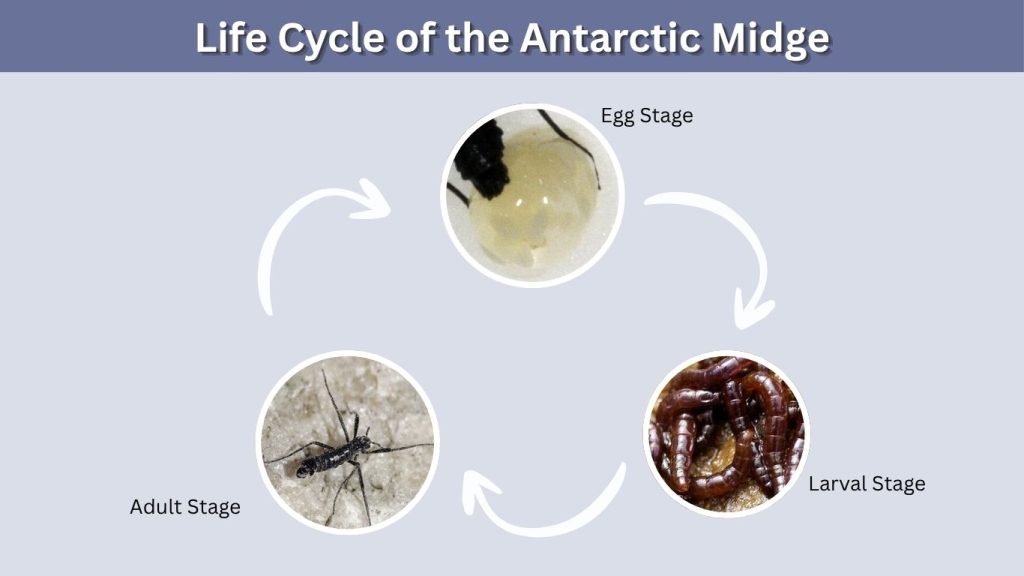
The Antarctic midge has a slow life cycle compared with many insects. In warmer places, tiny flies may complete development quickly. In Antarctica, growth is limited by cold temperatures and a short active season.
Much of the midge’s life is spent as a larva. The adult stage is brief and mainly used for mating and producing eggs.
Egg Stage
Females lay eggs in protected, moist places. The eggs need conditions that prevent drying and freezing damage. Moist organic material and sheltered surfaces help improve survival.
Because the Antarctic summer is short, timing is important. Eggs and young larvae must begin development when conditions allow some biological activity.
Larval Stage
The larval stage is the longest and most important part of the midge’s life. Larvae feed, grow, and survive through severe cold. They can enter dormant states when conditions are too harsh.
Larvae may take about two years to complete development. This slow pace is an adaptation to the extreme environment. Instead of rushing through life, the midge stretches development across short windows of seasonal activity.
Adult Stage
Adults emerge during the Antarctic summer. They do not live long. Their main tasks are to find mates and reproduce before conditions become unsuitable again.
Because adults are wingless, they move by crawling rather than flying. Mating often happens close to the larval habitat, reducing the need to travel far.
How the Antarctic Midge Survives Extreme Cold
The Antarctic midge is an extremophile, meaning it can tolerate environmental conditions that would kill many organisms. Its survival depends on cold tolerance, dehydration resistance, and seasonal dormancy.
Its body does not simply ignore the cold. Instead, it uses several biological strategies to reduce damage.
Survival Adaptations
- Can tolerate freezing conditions
- Uses dormancy during harsh periods
- Survives major water loss
- Produces protective compounds in the body
- Lives in buffered microhabitats
- Avoids wind exposure by being flightless
- Develops slowly over multiple seasons
- Times adult emergence with the brief summer
One of its most impressive adaptations is dehydration tolerance. Losing water may sound dangerous, but controlled dehydration can help reduce ice formation inside the body. Less internal water means less damaging ice during freezing conditions.
Cold, Dryness, and Dormancy
Antarctica is both cold and dry, so the midge must deal with freezing and dehydration together. Larvae can slow their metabolism and wait through unfavorable conditions. When warmth and moisture return, they resume development.
This ability is essential because good conditions may last only a short time. The insect must take advantage of summer quickly, then survive another long period of cold.
Why Scientists Study It
Scientists study the Antarctic midge because it provides clues about survival under extreme stress. Research on this insect helps explain how living cells respond to freezing, dehydration, osmotic stress, and seasonal dormancy.
Its biology is useful not only for entomology, but also for broader questions about adaptation, climate tolerance, and survival in extreme environments.
Antarctic Midge Genome
The Antarctic midge has attracted scientific attention because of its unusually compact genome. Its genome is very small compared with many other insects, making it an important species for studying how animals adapt genetically to extreme habitats.
A small genome does not mean the insect is simple. Instead, it shows that the species has a very efficient genetic structure.
Genome Facts
| Feature | Antarctic Midge Detail |
| Scientific name | Belgica antarctica |
| Genome size | About 99 megabases |
| Known for | Very compact insect genome |
| Research value | Extreme cold and dehydration tolerance |
| Habitat link | Antarctic terrestrial microhabitats |
| Adult movement | Crawling, not flying |
The genome has helped researchers examine how this insect handles environmental stress. It is especially interesting because the midge faces multiple threats at once: cold, drying, ultraviolet radiation, and short seasonal windows.
What the Genome Reveals
Genome studies suggest the Antarctic midge has reduced amounts of some non-coding DNA compared with many insects. This compactness may be connected to its extreme lifestyle, although survival depends on both genes and behavior.
The midge’s genome also supports research into stress-response pathways. These include responses to dehydration, freezing, and changes in body water balance.
Is the Antarctic Midge Dangerous?
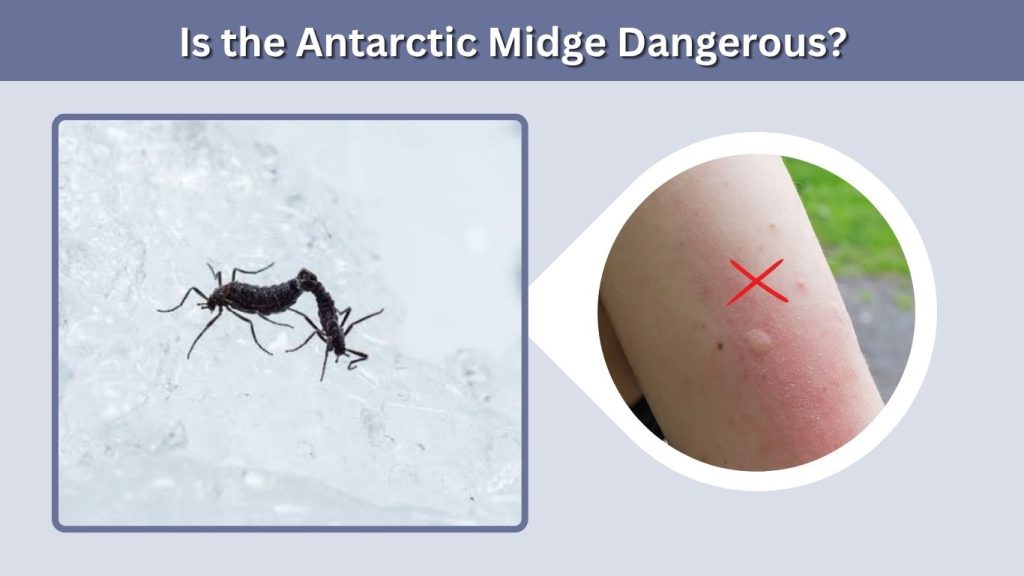
The Antarctic midge is not dangerous to humans. It does not bite, sting, or spread common human diseases. It is not a household pest and does not infest buildings in the way some flies or mosquitoes can.
Its importance is scientific and ecological rather than medical.
Human Interaction
Most people will never see an Antarctic midge in person unless they visit scientific or coastal Antarctic field sites. The insect is small and easy to overlook. Researchers, however, value it because it is one of the few native insects able to survive year-round in Antarctica.
It is not a species people need to control. Instead, it is a species worth protecting and studying.
Climate Change Concerns
The Antarctic midge is adapted to cold conditions, but that does not mean it can handle unlimited environmental change. Warming, habitat shifts, invasive species, and changes in moisture patterns could affect its future.
Because it lives in a specialized habitat, even small changes can matter. Its survival depends on the balance of cold, moisture, shelter, and seasonal timing.
Interesting Antarctic Midge Facts
The Antarctic midge proves that size does not define biological importance. This insect is tiny, but it represents one of the most extreme survival stories in the animal world.
Quick Facts
- It is also called Belgica antarctica.
- It is a flightless midge, not a mosquito.
- It is native to Antarctica.
- It is only a few millimeters long.
- It is considered Antarctica’s largest purely terrestrial native animal.
- It spends most of its life as a larva.
- Adults live briefly and focus on reproduction.
- It can survive freezing and severe dehydration stress.
- It has a notably compact insect genome.
- It does not bite humans.
The Antarctic midge is a perfect example of how life adapts to unusual places. While Antarctica is famous for penguins, seals, whales, and ice, this tiny wingless insect is one of its most remarkable land animals.
FAQs
What is the Antarctic midge?
The Antarctic midge is a tiny flightless insect known scientifically as Belgica antarctica. It is native to Antarctica and belongs to the non-biting midge family. Although it measures only a few millimeters long, it is often described as Antarctica’s largest purely terrestrial native animal.
Does the Antarctic midge have wings?
The Antarctic midge is wingless or functionally flightless. This is an important adaptation because strong Antarctic winds could blow flying insects away from suitable habitat. By staying close to the ground and crawling, the midge can remain in protected areas where survival is possible.
What does the Antarctic midge eat?
Antarctic midge larvae feed on algae, microorganisms, fungi, decaying organic material, and nutrient-rich debris in moist terrestrial habitats. Adults live briefly and focus mainly on reproduction. Most feeding happens during the larval stage, which is the longest part of the life cycle.
How big is the Antarctic midge?
The adult Antarctic midge is usually about 2–6 mm long. That is extremely small compared with animals people usually imagine, but Antarctica has very few true land animals. Because penguins and seals depend on the ocean, this tiny insect holds a surprising terrestrial title.
Why is the Antarctic midge important?
The Antarctic midge is important because it shows how insects can survive extreme cold, dehydration, short summers, and limited food. Scientists study it to understand stress tolerance, dormancy, genome adaptation, and life in harsh environments. It also plays a role in Antarctica’s simple land ecosystem.