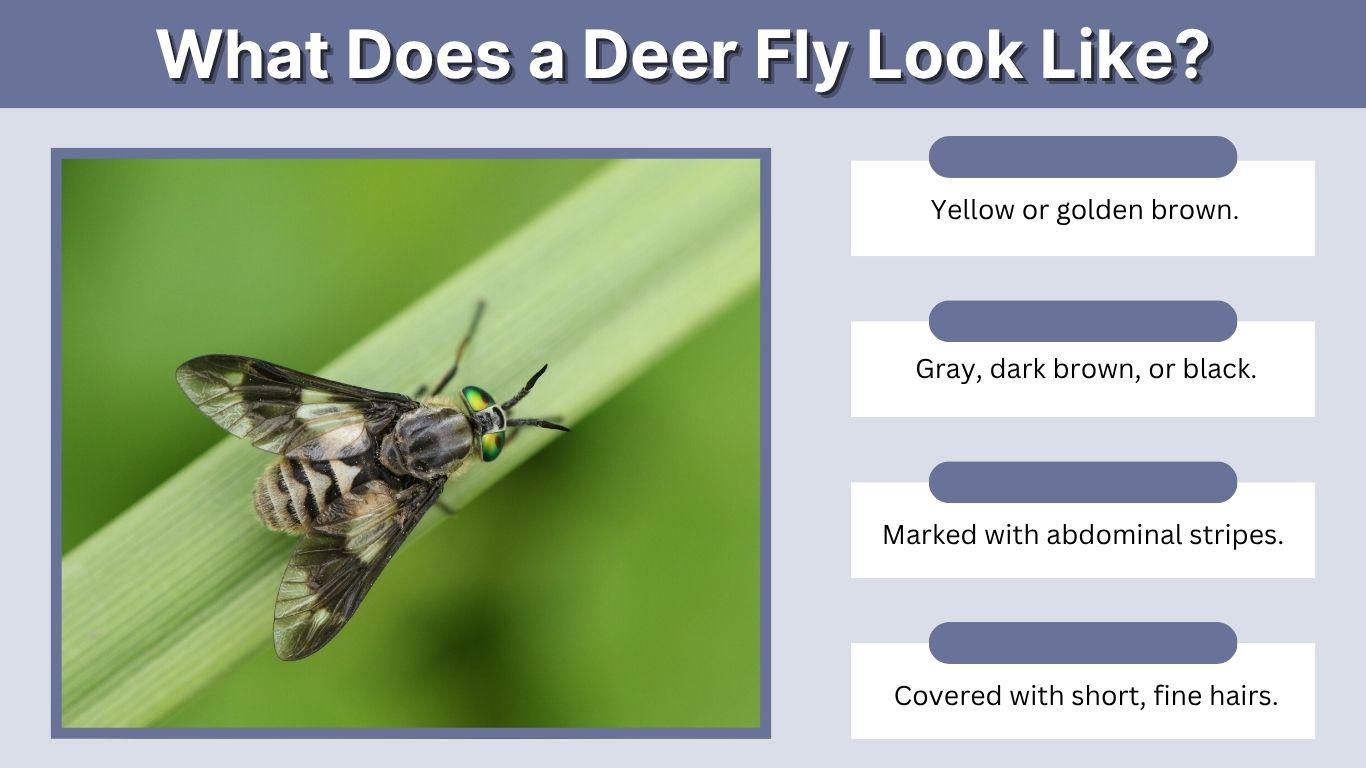
A deer fly looks like a large, sturdy housefly with brightly colored eyes and dark patterns across its wings. Most species have yellow, brown, gray, or black bodies marked with stripes or patches. Female deer flies are persistent daytime biters that often circle the head before landing. Their bites are immediately painful and may leave a red, swollen welt with a small bleeding spot.
What Is a Deer Fly?
Deer flies are biting flies in the family Tabanidae, the same family as horse flies and yellow flies. Most species commonly called deer flies belong to the genus Chrysops. They feed on plant sugars as adults, but females also require blood to produce eggs.
Although their name suggests that they mainly attack deer, they feed on many warm-blooded animals, including people, cattle, horses, dogs, and other wildlife. Some species may also feed on birds or reptiles.
What Does a Deer Fly Look Like?
Deer flies are slightly larger than typical houseflies but smaller than most horse flies. Exact appearance varies among species, so the patterned wings and colorful eyes are usually more useful for identification than body color alone.
Size and Body Shape
Most deer flies are approximately ¼ to ⅜ inch long. They have compact, somewhat flattened bodies, six slender legs, short antennae, and one functional pair of wings.
Their bodies may be:
- Yellow or golden brown
- Gray, dark brown, or black
- Marked with abdominal stripes
- Covered with short, fine hairs
- Broader through the thorax than the abdomen
Deer flies are usually more streamlined than large horse flies. However, they still look stronger and more muscular than mosquitoes, gnats, or ordinary houseflies.
Brightly Colored Eyes
The eyes are one of the most distinctive features. A living deer fly may have large green, gold, purple, or bronze compound eyes. Many species display horizontal or zigzag bands across the eyes.
The eyes can lose some of their bright coloring after the insect dies, so a preserved specimen may look less colorful than a living fly.
Dark Patterns on the Wings
Unlike most houseflies, deer flies usually have broad wings with noticeable dark markings. Depending on the species, these markings may appear as:
- Brown or black bands
- Smoky patches
- Dark wing tips
- Clear windows surrounded by brown
- Irregular spots extending across both wings
Dark-patterned wings are often the easiest way to distinguish a deer fly from a horse fly, whose wings are commonly clear or evenly darkened.
| Feature | Deer Fly | Housefly | Horse Fly |
| Typical size | About ¼–⅜ inch | About ¼ inch | Often ⅜–1¼ inches |
| Eyes | Green, gold, or banded | Usually reddish | Large and brightly colored |
| Wings | Dark bands or patches | Mostly clear | Often clear or evenly shaded |
| Body | Yellow, brown, or black | Gray with dark thoracic stripes | Broad, gray, brown, or black |
| Bites people | Females bite | No | Females bite |
What Do Baby Deer Flies Look Like?
Deer flies do not have miniature flying “babies.” They undergo complete metamorphosis through egg, larval, pupal, and adult stages.
Eggs
Females lay layered clusters of small eggs on leaves, stems, and other vegetation overhanging standing water or saturated ground. The egg masses may initially look pale but often darken before hatching.
Larvae
After hatching, the larvae fall into water, mud, or damp soil. Deer fly larvae are elongated, legless, and pale to brownish. They resemble narrow maggots but may have visible body rings and tapered ends.
The larvae live in wet habitats and feed on small organisms or decaying organic material. Depending on the species and environmental conditions, this developmental stage can last a long time.
Do Deer Flies Build Nests?
Deer flies do not build social nests like bees, wasps, or ants. Finding many adults in one place usually means that suitable wet larval habitat and animal hosts are nearby—not that a hidden nest exists in a tree or building.
What Does a Deer Fly Bite Look Like?
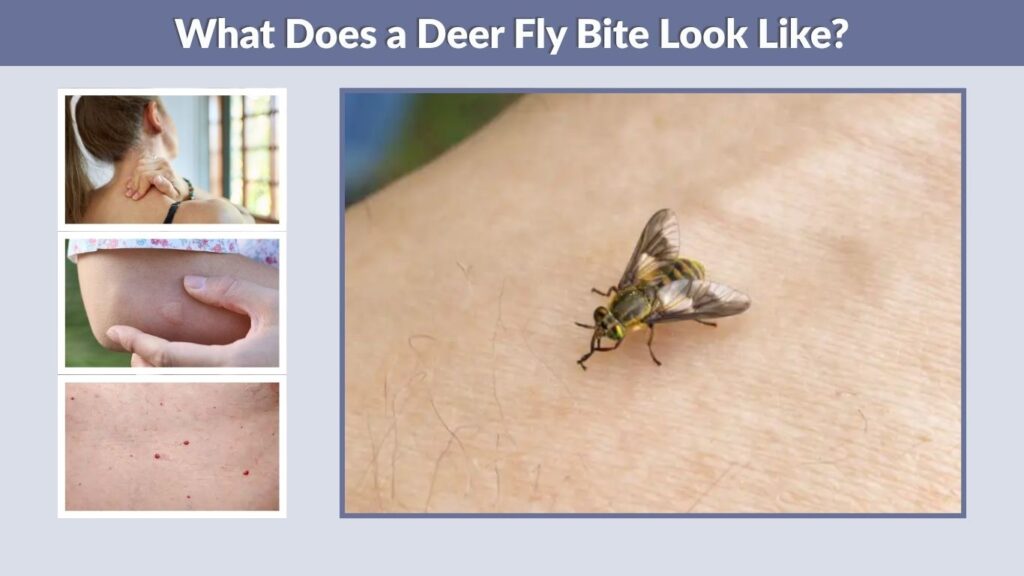
A deer fly bite commonly looks like a red, raised, swollen welt. There may be a small cut or bleeding point in the center because the fly slices the skin rather than piercing it with a thin feeding tube.
Common signs include:
- A red or darkened swollen bump
- A visible bleeding spot
- Warmth around the bite
- Itching or burning
- Tenderness when touched
- Swelling larger than the original wound
Redness can be harder to see on brown or black skin, but the area may still feel raised, warm, painful, or firm.
What Does a Deer Fly Bite Feel Like?
The bite usually causes immediate sharp, cutting, or burning pain. Female deer flies have blade-like mouthparts that cut the surface of the skin and allow blood to pool. This is why the bite may feel more like a small cut than a mosquito bite.
The area may remain sore or itchy for several days. People who develop a strong local reaction may experience considerable swelling around the bite.
Deer Fly Bite Treatment
Wash the area with soap and water, then apply a cold compress or a wrapped ice pack for about 20 minutes. Avoid scratching because broken skin can become infected. A pharmacist or healthcare professional may recommend an antihistamine, pain reliever, or hydrocortisone cream when appropriate.
Seek medical attention when the swelling or pain keeps worsening, redness spreads, pus appears, or you develop fever or swollen glands. Emergency care is necessary for breathing difficulty, faintness, widespread hives, or swelling of the face, mouth, tongue, or throat.
Where Do Deer Flies Like to Live?
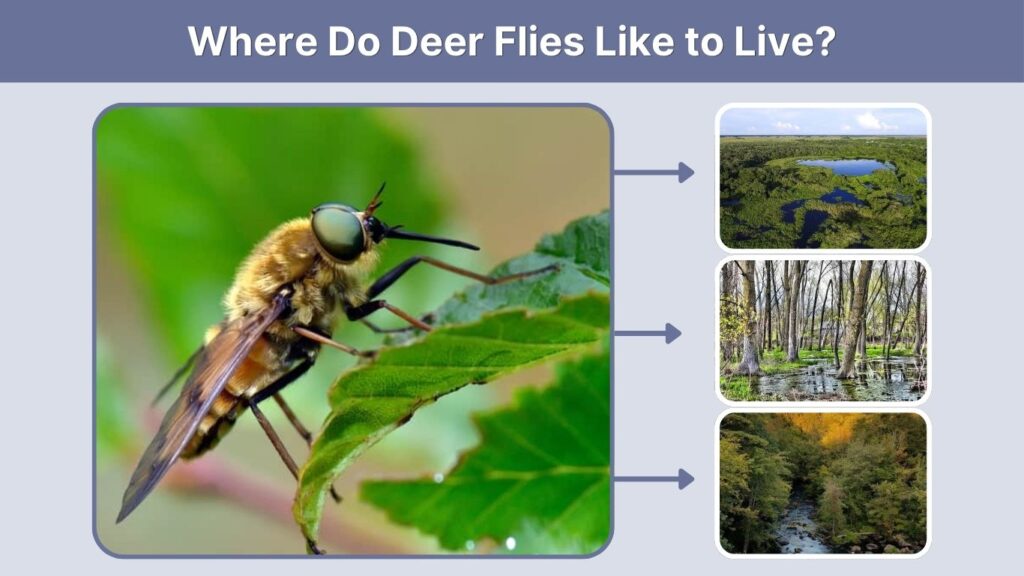
Deer flies are most common in damp natural environments where their larvae can develop. Typical habitats include:
- Freshwater wetlands
- Marshes and swamps
- Forests near water
- Muddy pond and lake edges
- Saturated fields or pastures
- Slow-moving streams
- Wooded hiking trails
Eggs are deposited on vegetation near wet sites, while larvae live in water, mud, or saturated soil. Adults may fly some distance from these breeding areas while searching for people or animals.
Do Deer Flies Like Sun or Shade?
Deer flies are primarily active during daylight. They can pursue people through sunny fields, forest paths, wetlands, and partly shaded areas. Their exact activity varies by species, temperature, wind, and weather, so neither full sun nor shade guarantees protection.
Entering a dark building, screened shelter, or enclosed vehicle is generally more effective than simply standing beneath a tree.
Why Do Deer Flies Like Me?
Being repeatedly targeted does not necessarily mean deer flies prefer your blood. Females locate hosts through a combination of signals, including:
- Movement
- Exhaled carbon dioxide
- Body size and shape
- Warmth and scent
- Strong contrast with the background
- Dark-colored clothing
Deer flies commonly target moving hosts and often fly around the head, neck, and shoulders. An interrupted female may quickly return and try to bite again.
Why Are Deer Flies Attracted to Blue?
Research and practical trap designs suggest that dark, strongly contrasting objects can attract tabanid flies. Blue objects are widely used in deer fly traps because they provide a noticeable visual target, especially when they move.
This does not mean every shade of blue attracts every deer fly species equally. Wearing light-colored clothing may simply make you less visually noticeable than black, navy blue, or other dark colors.
How to Avoid Deer Fly Bites
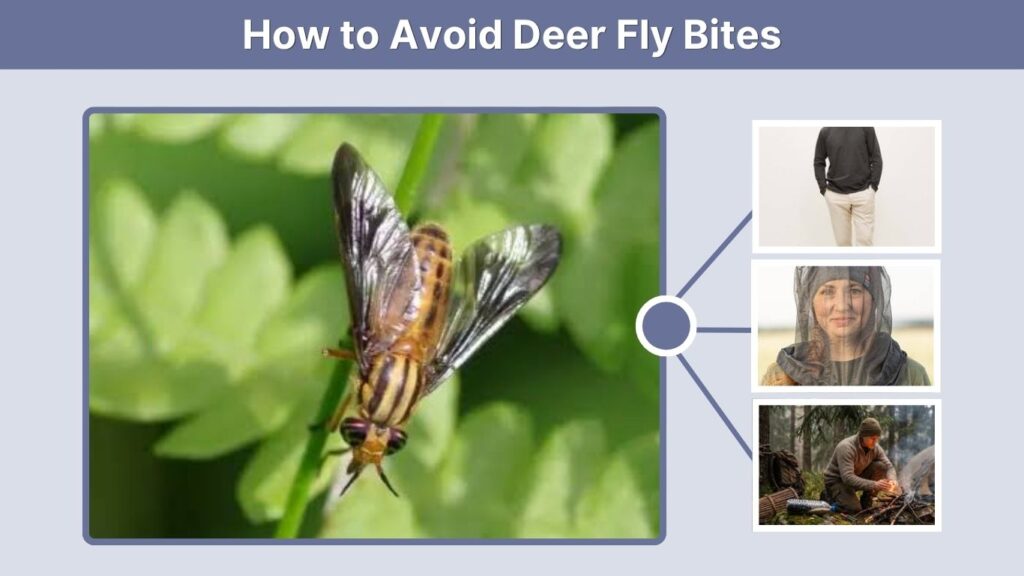
Deer flies can be difficult to repel because they are persistent and respond strongly to visual cues. Purdue Extension reports that conventional repellents, including DEET, may provide limited protection against heavy deer fly activity.
Helpful precautions include:
- Wear thick long sleeves and long pants.
- Use a hat or head net to protect your head and neck.
- Choose light-colored clothing.
- Avoid wet wooded areas during heavy activity.
- Enter a screened or enclosed space when pursued.
- Use an EPA-registered insect repellent according to its label.
- Avoid relying on yard sprays for long-term control.
The CDC recommends registered repellents and clothing that covers exposed skin to lower the risk of deer fly bites and tularemia.
Can Deer Flies Spread Disease?
Most deer fly bites cause only local pain, redness, and swelling. However, Chrysops deer flies can transmit tularemia in parts of the western United States. Possible warning signs include fever, swollen lymph nodes, and an ulcer near the bite site.
Contact a healthcare professional when unexplained fever, swollen glands, or a persistent ulcer develops after a deer fly bite.
FAQs
Are deer flies yellow or black?
They can be yellow, golden brown, gray, or black. Many species combine yellow and dark markings on the thorax and abdomen. Body color varies, but brightly colored eyes and dark-patterned wings are more dependable identification features.
How can you tell a deer fly from a housefly?
A deer fly generally has colorful, banded eyes and dark patches across its wings. A housefly typically has clear wings, reddish eyes, and four dark stripes on its gray thorax. Houseflies also do not bite people.
What time of day are deer flies most active?
Deer flies are daytime insects. Their activity often increases during warm weather when people and animals are moving through wetlands, forests, trails, and fields. Activity levels can change with temperature, wind, cloud cover, and species.
Why do deer flies follow your head?
They are attracted to movement, carbon dioxide, body shape, and dark visual targets. Deer flies also commonly feed on moving hosts and frequently target the head and shoulders, causing them to circle people persistently.
How long does a deer fly bite last?
Initial pain may fade within hours, while swelling, tenderness, or itching can remain for several days. Larger local reactions may last longer. Seek medical advice when the area keeps worsening, becomes infected, or is accompanied by fever or swollen glands.