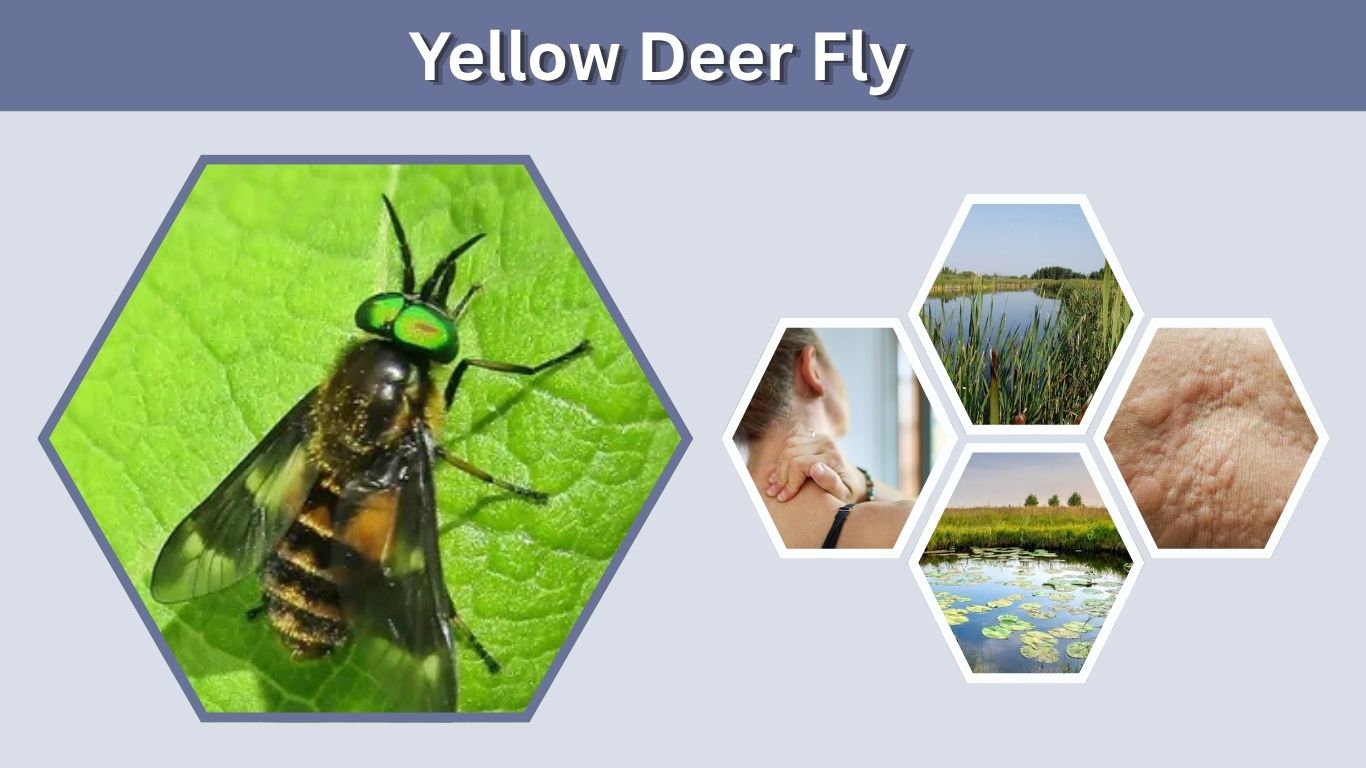
The term yellow deer fly commonly describes a yellow-colored biting fly that resembles a deer fly. However, it may refer either to a true deer fly in the genus Chrysops or to the true yellow fly, Diachlorus ferrugatus. These closely related flies can both deliver painful bites, but differences in their wings, eyes, body color, and distribution can help you tell them apart.
What Is a Yellow Deer Fly?
“Yellow deer fly” is an informal name rather than the accepted common name of one specific species. In places such as Florida, people use “yellow fly” for several yellow-bodied members of the horse and deer fly family, Tabanidae. Entomologists generally reserve the name true yellow fly for Diachlorus ferrugatus.
Most insects called deer flies belong to the genus Chrysops. They are usually smaller than horse flies and may have yellow, brown, or black bodies. The true yellow fly resembles a deer fly but belongs to a different group within the same family.
Are Deer Flies and Yellow Flies the Same?
No. Deer flies and yellow flies are related, but they are not exactly the same insect.
Deer flies are generally Chrysops species, while the true yellow fly is Diachlorus ferrugatus. Both belong to Tabanidae, have large compound eyes, develop in wet environments, and include blood-feeding females.
| Feature | Deer Fly | True Yellow Fly |
| Common genus | Chrysops | Diachlorus |
| Typical length | 7–10 mm | About 10 mm |
| Body color | Yellow to black, often striped | Mainly golden yellow |
| Wings | Dark bands or mottled patches | Brown patch near each wingtip |
| Eyes | Often gold, green, or patterned | Blue-green with two purple bands |
| U.S. distribution | Widespread | Mainly southeastern states |
| Bite | Sharp and painful | Sharp, painful, and persistent |
These identification features are based on descriptions from the University of Florida and Purdue Extension.
How to Identify a Yellow Deer Fly
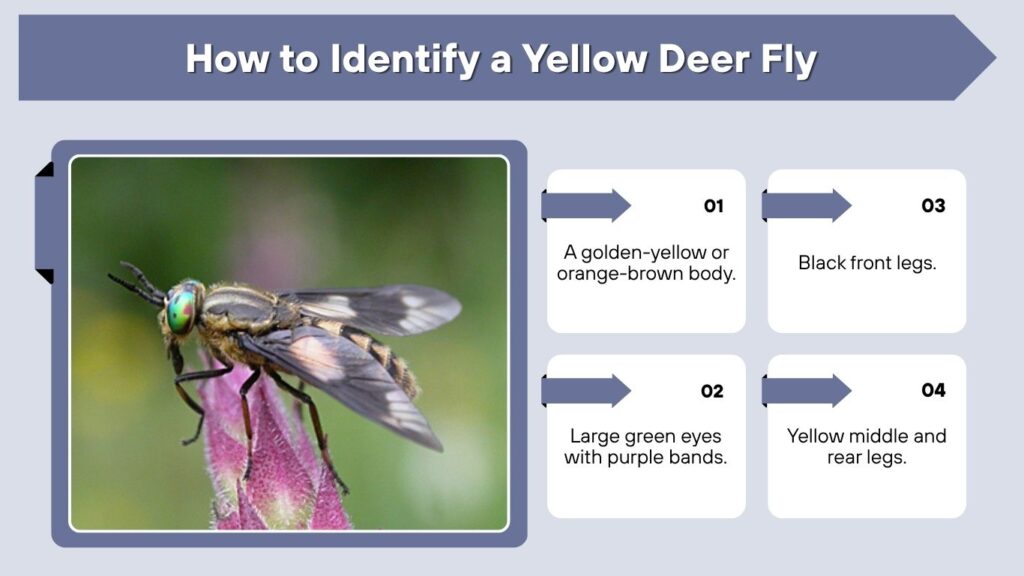
Identifying one of these flies by color alone can be misleading. Look closely at the wings, eyes, body markings, and size.
Body Color and Size
The true yellow fly is approximately ⅜ inch long and has a predominantly yellow or golden body. Its front legs are mostly black, while the middle and rear legs are yellow. A wide stripe of yellow hair runs along the center of its abdomen.
Typical deer flies measure around 7–10 mm long. Depending on the species, they can be yellow, brown, gray, or nearly black. Many have dark stripes running along the thorax or abdomen.
Eyes and Wings
The eyes of a living yellow fly are brilliant blue-green with two horizontal purple bands. Its mostly clear wings have a noticeable brown patch near the outer tip.
Deer flies generally have large, brightly colored eyes and dark markings across the middle of their otherwise clear wings. Their spotted or banded wings are among the easiest features to recognize.
Quick Identification Checklist
A suspected yellow fly may have:
- A golden-yellow or orange-brown body
- Large green eyes with purple bands
- Black front legs
- Yellow middle and rear legs
- Clear wings with brown outer tips
- A quiet but persistent flight
- A painful bite on exposed skin
A typical deer fly is more likely to have abdominal stripes and dark bands or patches extending across the middle of its wings.
Yellow Fly and Deer Fly Habitat
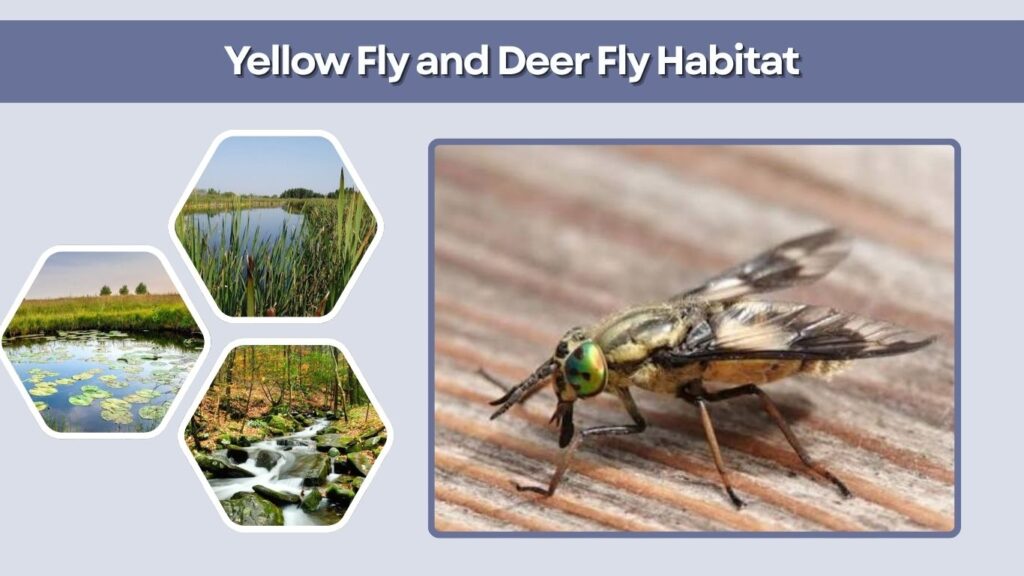
Both groups are closely associated with moist habitats because their larvae develop in water, mud, saturated soil, or wet organic material.
Where Yellow Flies Live
The true yellow fly occurs from New Jersey south to Florida and west to Texas. Its broader range continues through Mexico and parts of Central America. Adults are especially common around forests, shaded waterways, swamps, and large bodies of water.
Yellow fly larvae have been found beneath water in deeply shaded root mats around woody plants. Adults can travel away from these areas while searching for blood meals, although many remain near suitable larval habitat.
Where Deer Flies Live
Deer fly larvae commonly develop around:
- Marshes and wetlands
- Pond and lake margins
- Slow-moving streams
- Saturated woodland soil
- Damp vegetation near water
Adult deer flies usually appear from late spring through summer, although their exact season varies by region and species.
| Behavior | Deer Fly | Yellow Fly |
| Main activity period | Daytime | Daytime |
| Common habitat | Wetlands and wooded areas | Shaded forests near water |
| Host detection | Movement, shape, odor, CO₂ | Movement and nearby hosts |
| Frequent bite areas | Head, shoulders, and neck | Any exposed skin |
| Flight sound | Often noticeable nearby | Usually quiet |
| Peak activity | Varies by species | Often late afternoon or cloudy days |
Female tabanid flies locate hosts using visual and chemical signals, including movement, body shape, dark colors, odor, and carbon dioxide.
Yellow Deer Fly Bites
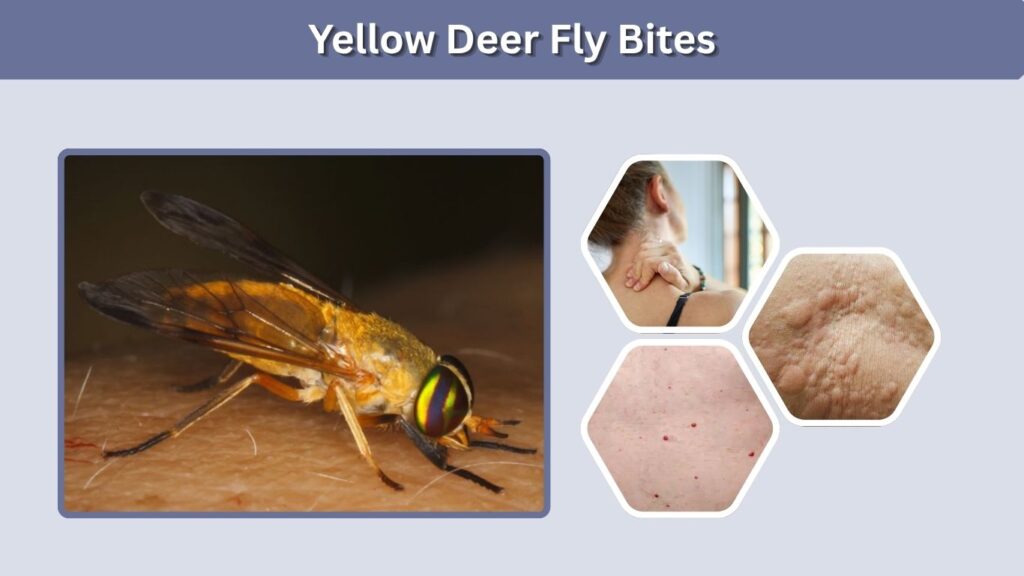
Only female deer flies and yellow flies take blood meals. Males mainly consume nectar, pollen, and other plant sugars. Females use blade-like mouthparts to cut the skin and then absorb the blood that collects at the wound.
This cutting action can produce immediate pain rather than the delayed itching associated with some mosquito bites.
Common Bite Symptoms
A yellow deer fly bite may cause:
- Sudden sharp or burning pain
- A small bleeding point
- Redness around the wound
- A raised, itchy welt
- Local warmth or tenderness
- Moderate or substantial swelling
Yellow fly bites can sometimes produce large, itchy swellings, especially in sensitive individuals.
Yellow Deer Fly Bite Treatment
For a mild reaction:
- Move away from the area to avoid more bites.
- Gently wash the wound with soap and water.
- Apply a cold, damp cloth or wrapped ice pack for 10–20 minutes.
- Raise the affected arm or leg if swelling is present.
- Consider calamine lotion or 0.5–1% hydrocortisone cream for itching.
- Avoid scratching or breaking the skin.
A nonprescription antihistamine or pain reliever may help some people when used according to the product directions. Seek medical care if swelling continues to worsen, the wound develops signs of infection, or you begin feeling unwell.
Emergency help is needed for difficulty breathing, dizziness, fainting, widespread hives, or swelling of the lips, face, tongue, or throat.
Can Deer Flies Spread Disease?
Most bites result only in a local skin reaction. However, deer flies in the genus Chrysops can transmit tularemia in parts of the western United States. Tularemia may cause fever, swollen lymph nodes, and an ulcer near the bite site.
A person who develops fever, a persistent skin ulcer, or swollen lymph nodes after a suspected deer fly bite should contact a healthcare professional.
How to Get Rid of Yellow Deer Flies
Completely eliminating deer and yellow flies from a property is difficult. Their larvae are widely distributed through natural wetlands and saturated soil, making broad larval treatment impractical and potentially damaging to aquatic habitats.
Reduce Bites Around Your Property
Practical measures include:
- Trim dense vegetation near patios and walkways.
- Use screened porches or enclosed outdoor areas.
- Avoid shaded waterfront locations during heavy activity.
- Wear thick, long-sleeved clothing and long pants.
- Choose light-colored clothing instead of dark colors.
- Protect the head and neck with a hat or head net.
- Keep doors and window screens in good condition.
Repellents may provide some protection, but deer flies can continue attacking even when DEET is used. Physical barriers are often more dependable when fly numbers are high.
Do Yellow Deer Fly Traps Work?
Traps can capture deer and yellow flies within small locations such as yards, campsites, livestock enclosures, and swimming areas. Many designs use a moving dark or shiny object that attracts females searching for a host.
However, traps rarely eliminate the entire population. They are best used to reduce activity around a limited area rather than as a complete property-wide solution.
Yellow Deer Fly vs Yellow Jacket
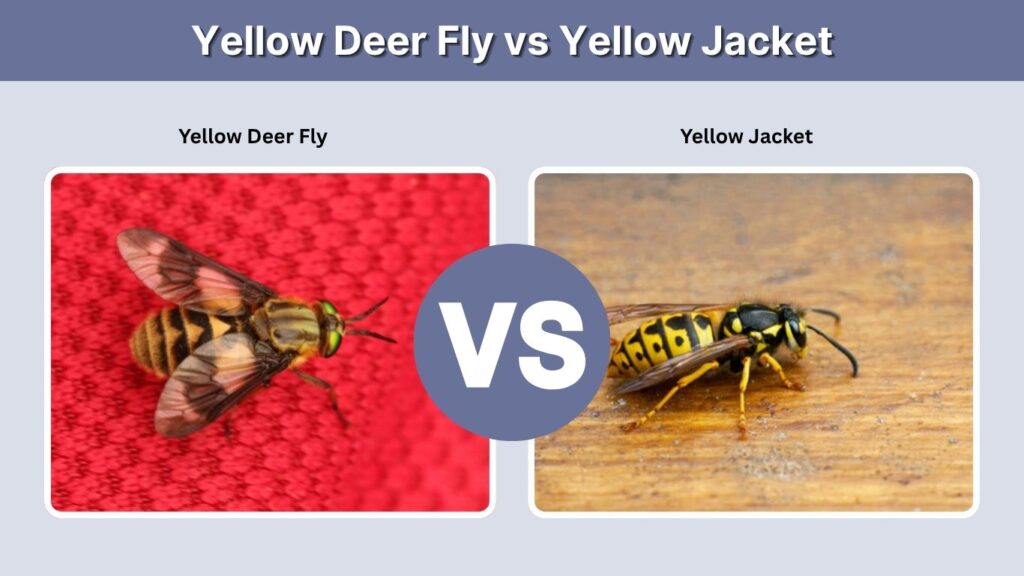
A yellow deer fly should not be confused with a yellow jacket. Yellow jackets are social wasps, while deer flies are true flies.
| Feature | Yellow Deer Fly | Yellow Jacket |
| Insect group | Fly | Wasp |
| Wings | One functional pair | Two pairs |
| Body shape | Broad body with large eyes | Narrow waist with black-yellow pattern |
| Method of injury | Cuts and bites the skin | Injects venom with a stinger |
| Social nest | No | Yes |
| Can attack repeatedly? | May return and bite again | Can sting repeatedly |
FAQs
What is a yellow deer fly?
A yellow deer fly is an informal name for a yellow-colored biting fly in the Tabanidae family. It may describe a true Chrysops deer fly or the true yellow fly, Diachlorus ferrugatus, which is recognized by its golden body and green-and-purple eyes.
Are yellow flies and deer flies the same?
They are closely related but not identical. Most deer flies belong to the genus Chrysops, while the true yellow fly is Diachlorus ferrugatus. Both have blood-feeding females, but their wing markings, eye patterns, body colors, and geographic distributions differ.
How long does a yellow deer fly bite last?
Pain may improve within a few hours, but redness, itching, tenderness, or swelling can remain for several days. Healing time depends on the person’s reaction and whether the wound is scratched. Worsening redness, pus, fever, or continued swelling should be medically evaluated.
What is the best yellow deer fly repellent?
DEET-containing repellents may offer limited protection, but they are not always dependable against persistent deer flies. Protective clothing, a thick hat, a head net, and avoiding heavily infested wet or wooded areas generally provide more reliable protection when populations are high.
Why do deer flies circle around your head?
Female deer flies are attracted to movement, body shape, dark colors, carbon dioxide, and other host signals. They frequently pursue moving people and target the head, neck, and shoulders. A light-colored hat or head net can help prevent them from reaching exposed skin.